The Epistle on Conduct and Wisdom
An anonymous compiler brings together good conduct, faith and friendship. He invokes a verse about the distribution of sustenance, weighs prudence against generosity, then quotes poets and men of letters of the Abbasid era. The catalogue entry and the colophon give this small collection two different designations.
Sources and method of compilation
Historical context
Dating
639 AH, or 1241–1242, is the date of the copy. The date of composition remains unknown.
Origin and preservation
British Library, Oriental Manuscripts collection, Add MS 7473, ff. 31v–33r, now available through the Qatar Digital Library. The copyist inserted the epistle between two treatises.
How the volume was compiled
The four manuscript images were read directly. The text begins on 31v after the end of the treatise by Sinān ibn Thābit. The following treatise is announced at the end of the colophon. The six divisions, punctuation and spelling used for the reading are editorial.
Several sequences of words on the recto and verso of f. 32 are difficult to establish. The symbol [؟] marks an uncertain reading. Other square brackets indicate a reconstruction or clarify a difficulty. Gaps in interpretation are retained in the translation.
On f. 32r, the quotation from Quran 42:27 ends at “on the earth”. The sentences that follow, concerning work and mutual need, are the compiler’s commentary. The colophon also repeats the end of Quran 73:9.
Early parallels shed light on several sayings. The observation about prudence before success or failure also appears in al-Ḫarāʾiṭī’s Makārim al-aḫlāq. Ibn
Qutayba also reports al-Aṣmaʿī’s remark about dirhams, but his version gives a higher sum. These parallels do not allow the whole compilation to be attributed to their authors.
The heading contains يتضمن and two nouns without written inflectional endings. The closing phrase reads “selected pieces of belles-lettres and their supplements”. Searches by title, shelfmark and incipit lead to manuscript catalogue entries. No commercial edition of this exact arrangement has been identified. Several individual maxims circulate elsewhere.
Sources and references
Read the textual witness and its catalogue entries
Qatar Digital Library / British Library, Add MS 7473, ff. 31v–33r, catalogue entry for the ↗ compilation and colophon.
Ibn Qutayba, ʿUyūn al-aḫbār. Parallel to al-Aṣmaʿī’s remark. ↗
Al-Ḫarāʾiṭī, Makārim al-aḫlāq, chapter on prudence, parallel saying. ↗
Al-Rāġib al-Iṣfahānī, Muḥāḍarāt al-udabāʾ. Parallel to the maxim on reason and ↗ passion.
Image credits
Arabic section · passage 1. British Library, Add MS 7473, f. 31v, detail. Qatar Digital Library, public domain.
Arabic section · passage 2. British Library, Add MS 7473, f. 32r, detail. Qatar Digital Library, public domain.
Arabic section · passage 3. British Library, Add MS 7473, f. 32r, detail. Qatar Digital Library, public domain.
Arabic section · passage 4. British Library, Add MS 7473, f. 32v, detail. Qatar Digital Library, public domain.
Arabic section · passage 5. British Library, Add MS 7473, f. 32v, detail. Qatar Digital Library, public domain.
Arabic section · passage 6. British Library, Add MS 7473, f. 33r, detail. Qatar Digital Library, public domain.
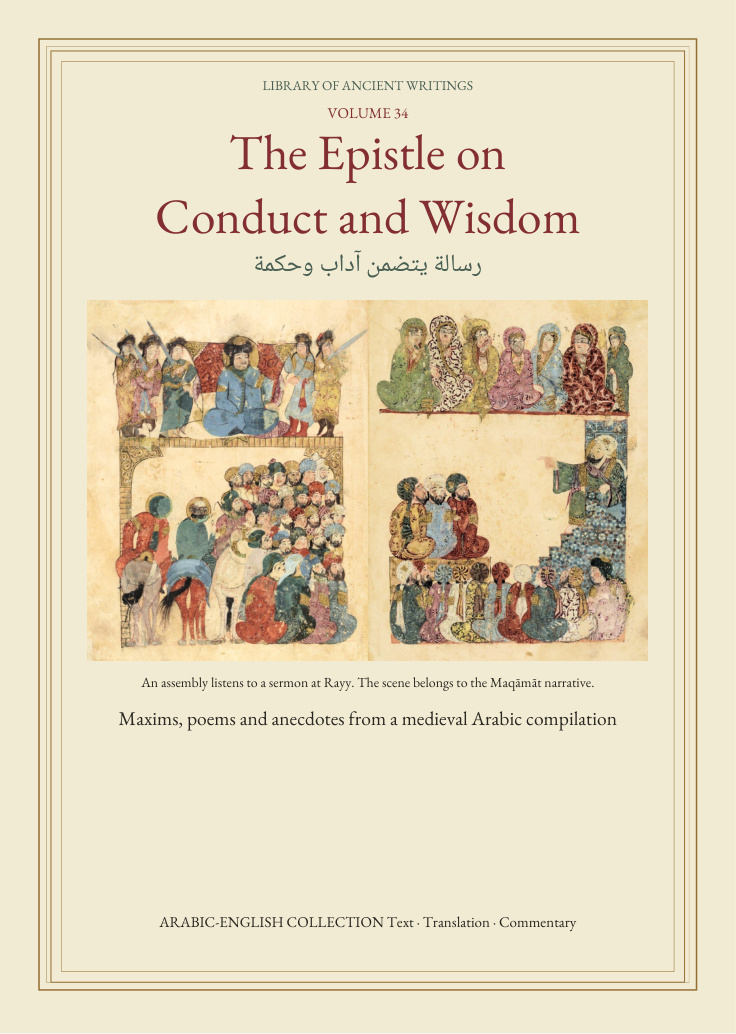
Cover. Al-Wāsiṭī, Maqāmāt of al-Ḥarīrī, 1236–1237. Paris, BnF, Arabe 5847, ff. 58v–59r. ↗
Translation · passage 2. Yaḥyā al-Wāsiṭī, Maqāmāt of al-Ḥarīrī, Baghdad, 1236–1237. Paris, BnF, ↗ Arabe 5847, f. 5v.