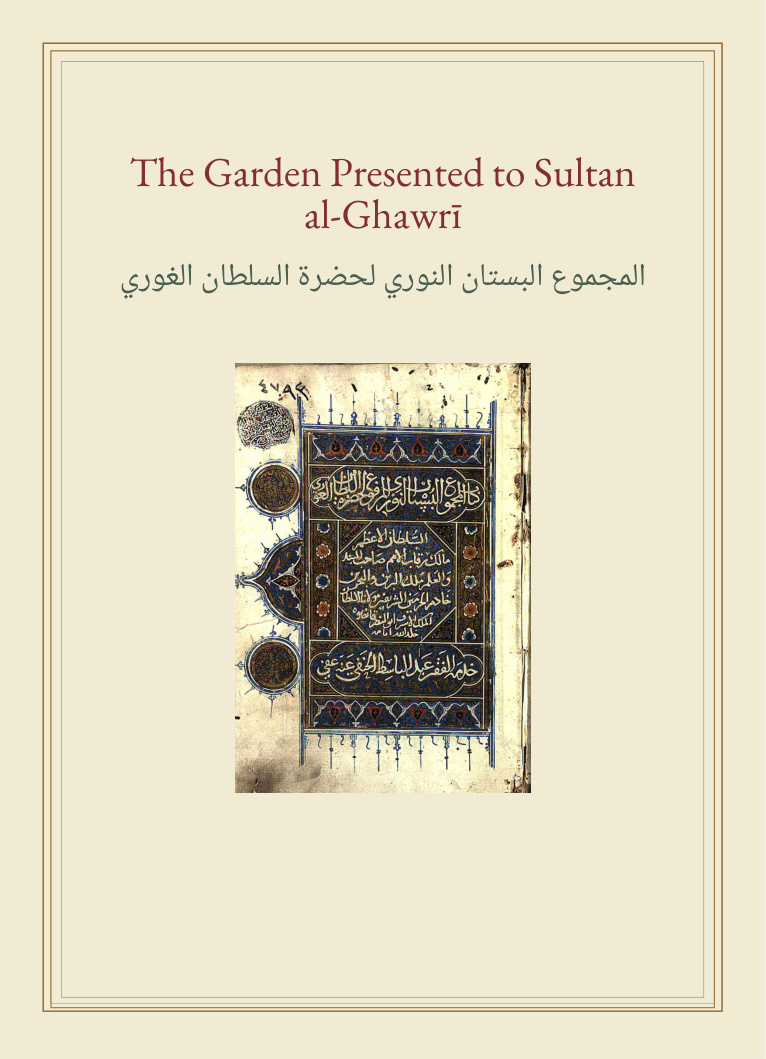
The Garden Offered to Sultan al-Ghawrī
What does “the Merciful” convey that “the All-Merciful” does not? Why attribute the dawn prayer to Adam? The jurist answers by commenting on the Quran, recounting the lives of the prophets and relating traditions about prayers. He also sketches the vocal apparatus and places the Kaʿba at the centre of a compass rose.
Sources and method of compilation
Historical context
Dating
ʿAbd al-Bāsiṭ al-Malaṭī assembled these works for the Mamluk sultan Qānṣūh al-Ghawrī in 919 AH (1513–1514). Some of the treatises had been composed earlier.
Origin and preservation
Istanbul, Süleymaniye Library, Ayasofya collection, manuscript 4793. The frontispiece names the sultan and the author. K. D’hulster describes this manuscript of 218 folios as the only known copy of the collection. Each of the fourteen treatises has its own decorated title page.
How the volume was compiled
A folio has two sides. “r” refers to the recto and “v” to the verso. The links open a two-page spread; the cited recto is on the left and the cited verso on the right. Some works share the same side of a folio. The English titles, translated from the French, guide the reader, while the manuscript’s Arabic titles remain in the text.
The compiler brings together several traditions about the same prophet. When he mentions the Torah or the Gospel, these references reflect his reading and his sources. They do not identify a specific version of the Bible. The account of Jesus and the narrative about the origin of the five prayers appear in two different treatises.
The book of wonders preserves narratives and uses attributed to verses, substances, animals and celestial bodies. The translation conveys these claims in their historical context, retaining the cautions expressed by the compiler.
The collection as a whole is described as unique. Some of the treatises it brings together also circulated separately. The Life of Muḥammad, for example, was printed in Beirut in 1988, and the treatise on the qibla was edited in 2024. The final treatise in the table of contents is the one on the qibla. The pages of poetry that follow include a piece in Turkish, an elegy composed on the death of al-Suyūṭī and verses about the Nile. The final medallion contains an allusion to Quran 83:26.
Sources and references
Read the manuscript witness and its catalogue entries
Colour images of the manuscript, Ayasofya 4793, 219 images ↗
K. D’hulster, Browsing through the Sultan’s Bookshelves, Bonn edition, 2024, entry ↗ 51, pp. 125–130
L. K. Bilgin, study and edition of the treatise on the qibla, Kilitbahir 24, 2024 ↗
Rāʾid Amīr ʿAbd Allāh, study of the collection al-Bustān al-nawrī, University of Mosul, ↗ 2022
Image credits
Cover. Istanbul, Süleymaniye, Ayasofya 4793, f. 1r. ↗
Arabic section · passage 2. Istanbul, Süleymaniye, Ayasofya 4793, f. 14r. ↗
Translation · passage 3. Istanbul, Süleymaniye, Ayasofya 4793, f. 27r. ↗
Arabic section · passage 4. Istanbul, Süleymaniye, Ayasofya 4793, f. 36r. ↗
Translation · passage 5. Istanbul, Süleymaniye, Ayasofya 4793, f. 58r. ↗
Arabic section · passage 6. Istanbul, Süleymaniye, Ayasofya 4793, f. 72r. ↗
Translation · passage 10. Istanbul, Süleymaniye, Ayasofya 4793, f. 124r. ↗
Arabic section · passage 11. Istanbul, Süleymaniye, Ayasofya 4793, f. 144r. ↗
Arabic section · passage 12. Istanbul, Süleymaniye, Ayasofya 4793, f. 151r. ↗
Translation · passage 13. Istanbul, Süleymaniye, Ayasofya 4793, f. 171r. ↗
Translation · passage 16. Istanbul, Süleymaniye, Ayasofya 4793, f. 196r. ↗
Arabic section · passage 18. Istanbul, Süleymaniye, Ayasofya 4793, f. 208r. ↗
Translation · passage 19. Istanbul, Süleymaniye, Ayasofya 4793, f. 218r. ↗
Translation · passage 18. Ignace Mouradgea d’Ohsson, Tableau général de l’Empire othoman, ↗ plate XLV. Engraving of the courtyard and its galleries.