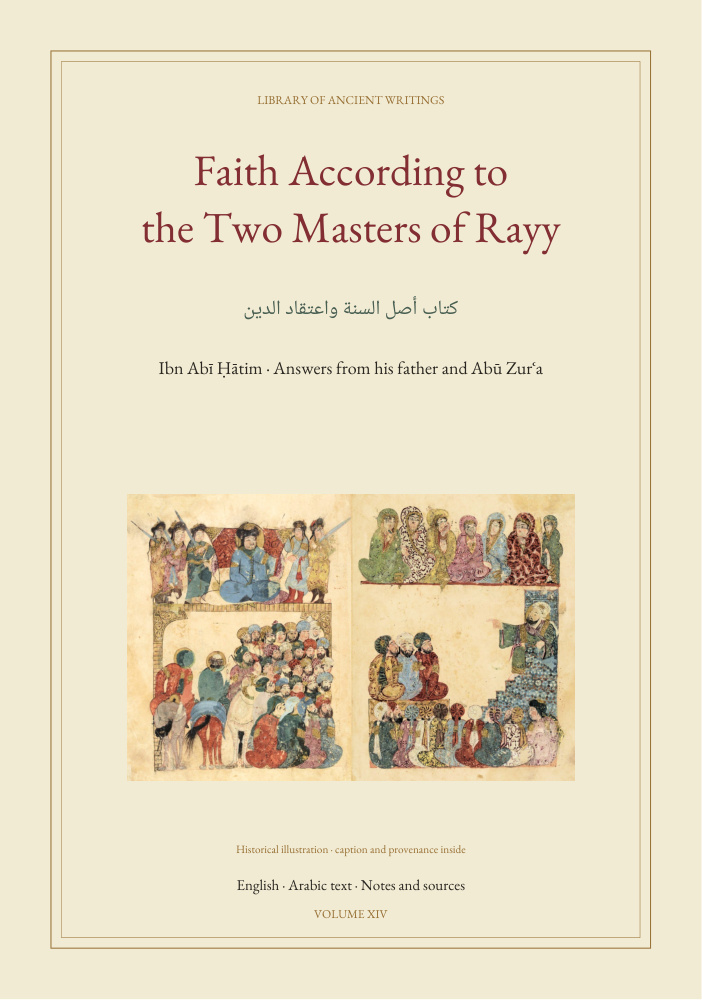
Faith According to the Two Masters of Rayy
A pupil questions his father and another traditionist about the convictions they have gathered from their teachers. Their answers address sin and membership of the community, Judgement and intercession. When they speak of the Quran and the voice of the person reciting it, the controversies of their time can be heard.
Sources and method of compilation
Historical context
Dating
The reported conversation took place before Abū Zurʿa’s death in 264 AH (878). The second teacher questioned, Abū Ḥātim, died in 277 AH (890). The date when it was written down and the date of the Damascus copy remain undetermined.
Origin and preservation
Ibn Abī Ḥātim collected the answers of two masters of Rayy, in present-day Iran. The short work appears in miscellany 3748 of the al-Ẓāhiriyya Library in Damascus, al-ʿUmariyya collection 11.
How the volume was compiled
ʿAbd al-Raḥmān ibn Abī Ḥātim (died 327 AH / 938) questions two traditionists of Rayy, in present-day Iran. His father Abū Ḥātim died in 277 AH / 890 and Abū Zurʿa in 264 AH / 878. The conversation therefore predates 878, while its written record and the manuscript have different dates.
The passage containing Quran 42:11 quotes the words about God’s incomparability, hearing and sight. The section devoted to the “created Quran” belongs to the controversies of the third century AH over divine speech and the reciter’s voice.
The condemnations translated are those of the teachers quoted. Their names for groups often designate an opponent as they perceive him. The images of the bridge, the basin, the angels and intercession place the doctrine within a specific representation of Judgement.
In the first lines of image 3, the sentence about the decree contains a negation whose position varies between transmissions. The French conveys the meaning given to the passage, namely God’s foreknowledge. The final paragraph retains the designations legible in the Damascus copy, with modern punctuation. Other witnesses and editions exist.
Damascus 3748, manuscript scan, from the bottom left of image 1 to the top ↗ right of image 4
Identification of the Ẓāhiriyya witness and characteristics of the facsimile ↗