The Epistle of Barnabas
An early Christian letter in twenty-one chapters
The Epistle of Barnabas is an early Christian work transmitted in Greek under the name of Barnabas. It offers a spiritual interpretation of biblical precepts and narratives, then sets out the two ways of light and darkness. It takes the form of a letter of instruction addressed to believers.
This volume presents all twenty-one chapters in full, each followed by Translation Choices. Difficulties in the text, useful Greek terms and alternative readings are explained alongside the relevant passage.
This Epistle is a separate work from the Gospel of Barnabas preserved in an Italian manuscript of the Renaissance. The name in its title does not, by itself, establish its author's historical identity. [SINAI ; OGER1907]
Sources and method of compilation
How the volume was compiled
The transmitted text
A witness (a manuscript or early edition that transmits the text to us) preserves a particular form of a work. Documents may differ in a word, a sentence, a name or the order of passages. Comparing them helps us understand the transmitted text; it does not, by itself, prove the historical truth of its claims.
The Codex Sinaiticus preserves the Epistle of Barnabas after the books of the New Testament. The French edition followed here uses the customary division into twenty-one chapters and one hundred and ninety-four paragraphs. These markers help readers locate passages and notes. [SINAI ; GREC]
Translation basis and checks
The French translation underlying this English version was based on the Greek text reproduced in the Greekdoc electronic transcription. Each chapter was compared with the early French translation published by Hemmer, Oger and Laurent in 1907. Kirsopp Lake's early English version, published in 1912, and Lightfoot's English displayed alongside the Greek were also consulted for difficult readings. [GREC ; OGER1907 ; LAKE1912]
This is not a new critical edition based on a word-by-word collation of all the manuscripts. Where a difference is noted, the note specifies the Greek form or translation actually consulted. An explanation proposed by a translator is not presented as a second, certain manuscript reading.
The French revision aims for natural sentences, pronouns whose referents remain identifiable, and concrete terms. Long constructions have sometimes been divided into several sentences. Lists, numbers, repetitions that serve the argument, and contrasts expressed by the author have been retained.
Reading the Translation Choices
Each chapter is immediately followed by its Translation Choices. These notes explain decisions that materially affect understanding: a word's meaning, a name shared by two figures, an ellipsis, an obscure passage or a difference between the editions consulted. They offer alternative formulations where the Greek allows more than one reading.
Quotation marks distinguish quotations and reported speech. Biblical quotations are translated as they appear in the Epistle, without being rewritten to match a modern Bible. Explanatory parentheses and the names of Greek letters make certain arguments accessible to readers unfamiliar with ancient languages.
The work contains its author's religious interpretations and polemics. They are translated as such, retaining their intended audiences and distinctive wording. Translation observations remain separate from these assertions. The reproduced images are identified historical works; they illustrate the book's transmission and themes.
Sources and references
GREC. Epistle of Barnabas, complete Greek text and J. B. Lightfoot's English in a modernised presentation, Greekdoc.
Greek source text for the French edition, twenty-one chapters. That edition consulted the electronic transcription and its indicated variants; the parallel English serves as a secondary check.
https://greekdoc.github.io/early/barnabas.html ↗
OGER1907. Hippolyte Hemmer, Gabriel Oger and A. Laurent, Les Pères apostoliques: Doctrine des Apôtres; Épître de Barnabé, Paris, Alphonse Picard et fils, 1907.
Early French translation consulted in full, chapter by chapter, for the French edition. Formulations and interpretations not adopted are discussed in the notes.
https://bkv.unifr.ch/fr/works/cpg-1050/versions/epitre-de-barnabe ↗
LAKE1912. Kirsopp Lake, The Apostolic Fathers, volume I, 1912: The Epistle of Barnabas, English translation.
Early English version consulted for the French edition to compare meaning and difficult constructions.
https://www.earlychristianwritings.com/text/barnabas-lake.html ↗
SINAI. Codex Sinaiticus Project, description of the manuscript's contents.
Institutional account attesting the Epistle's presence in the Codex Sinaiticus. This volume does not claim to have collated all the pages of that manuscript.
https://codexsinaiticus.org/en/codex/content.aspx ↗
LEXIQUE. Logeion, University of Chicago: Greek lexicons, entry γλωσσώδης.
The French edition's lexical check of the meaning ‘talkative’ or ‘loquacious’ at 19, 7; the term differs from δίγλωσσος, speaking with duplicity.
https://logeion.uchicago.edu/γλωσσώδης ↗
lsj_dikaioma. Liddell–Scott–Jones, Greek–English Lexicon, entry δικαίωμα, Scaife/Perseus.
The French edition's lexical check of the term used at I, 2, distinguishing precepts, decisions and acts of righteousness.
The captions identify the reproduced works and their periods. The images accompany the text; they are not presented as contemporary depictions of the events narrated.
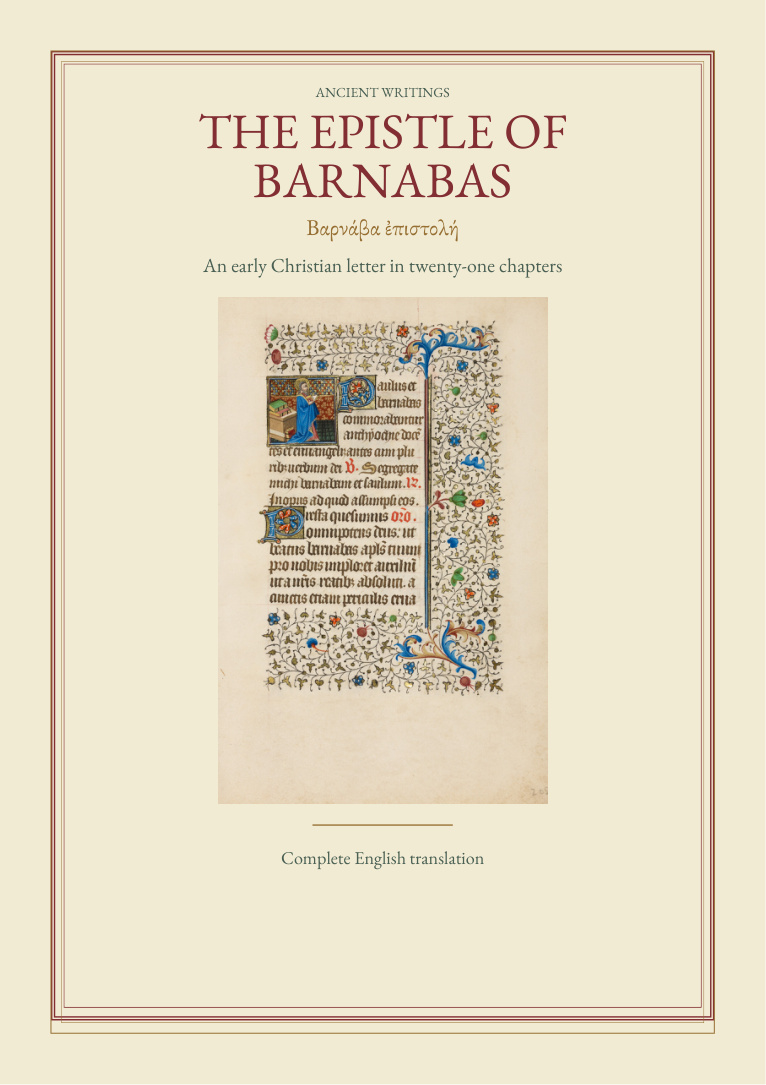
Saint Barnabas Reading a Book
J. Paul Getty Museum, Ms. Ludwig IX 6, fol. 208, 83.ML.102.208. Tempera colours, gold leaf and paint, ink on parchment. Image released under CC0 by the Getty Open Content Program. This liturgical image of Barnabas postdates the text.
https://www.getty.edu/art/collection/object/105VJQ ↗
The Baptism of Jesus
T’oros the Deacon, Baptism, one of the Four miniatures of the life of Christ from a gospel book of 1311. Ink and pigments on paper. The Metropolitan Museum of Art, group 2020.142.1–.4, Purchase, Giorgi Family Foundation Gift, 2020. Open Access image, public domain. Leaf reproduced without retouching its contents.
https://www.metmuseum.org/art/collection/search/751462 ↗
The Angels Hold Back the Four Winds
Leaf from a Beatus Manuscript: Angels Restrain the Four Winds; the Angel Ascends from the Rising Sun. Spain, c. 1180; tempera, gold and ink on parchment. The Metropolitan Museum of Art, 1991.232.7. Purchase, The Cloisters Collection, Rogers and Harris Brisbane Dick Funds, and Joseph Pulitzer Bequest, 1991. Open Access image, public domain.
https://www.metmuseum.org/art/collection/search/466202 ↗
Feeding the Hungry
Abraham Bosse, Feeding the Hungry, 1635; publisher Jean I Leblond. Etching and engraving, 25.8 × 32.6 cm. The Metropolitan Museum of Art, 26.49.15, Harris Brisbane Dick Fund, 1926. Open Access image, public domain. Reproduction resized.
https://www.metmuseum.org/art/collection/search/385967 ↗
Cover: Bedford Master, book of hours, Paris, c. 1440–1450. Illumination on folio 208, Ms. Ludwig IX 6.