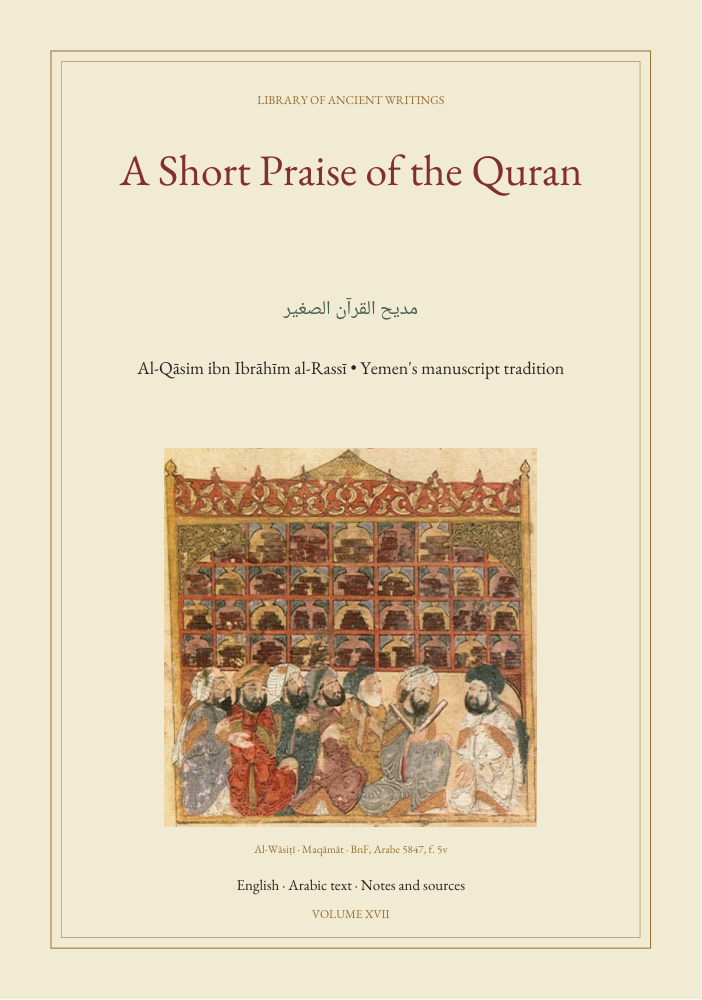
A Short Praise of the Quran
Al-Rassī evokes the light of the Quran and the fruits reaped by those who follow its guidance. In rhymed prose, he reflects on what the Book asks of its reader. His praise then becomes a commentary on the Fātiḥa and the first imperative of revelation, “Read”.
Sources and method of compilation
Historical context
Dating
Al-Qāsim ibn Ibrāhīm al-Rassī, who died in 246 AH (860), composed this work of praise in the ninth century. The editor dates one of the Sanaa copies to the sixth or seventh century AH, approximately the twelfth–thirteenth centuries.
Origin and preservation
The work was transmitted in Yemen. Jadbān’s edition compares several manuscripts, including a copy from the library of the Great Mosque of Sanaa whose scribe left no name.
How the volume was compiled
The manuscript designated ج by ʿAbd al-Karīm Aḥmad Jadbān comes from the library of the Great Mosque of Sanaa. The editor describes 328 pages with neither a date nor a copyist’s name and proposes the sixth or seventh century AH. This estimate concerns the copy; the author died in 246 AH (860).
The Arabic text follows Jadbān’s edition (volume II, pp. 31–39), established from several copies, including those from Sanaa. Copy ج is expressly cited among the variants of this short work. The titles in square brackets come from the edition. A written form on page 32, توره, is understood as نوره in the translation.
The rhythm of the Arabic prose rests on pairs of verbs and rhyming clause endings. The translation retains the contrasts and imagery without seeking to reproduce every rhyme. The view of which surah was revealed first is expressly the author’s.
ʿAbd al-Karīm Aḥmad Jadbān (ed.), Majmūʿ kutub wa-rasāʾil al-imām al-Qāsim, ↗ vol. II, pp. 29–39. Dār al-Ḥikma al-Yamāniyya, 1422 AH.
Description of the manuscript from the Great Mosque of Sanaa, siglum ج, vol. I, pp. 171 and 175–176.