The Life of Jesus Attributed to John
John recounts the life of Jesus, has him converse with the patriarchs and gives animals a voice. Lazarus comes out of the tomb before a crowd. Jesus then describes the end times to the disciples. At several points, the narrative moves abruptly from one episode to another. Finally, prayers and a lending note shed light on the manuscript’s history.
Sources and method of compilation
Historical context
Dating
The copy bears the date Thursday, 29 Āb, in the year 592 AH, corresponding to 1196. The date when the work was composed remains unknown.
Origin and preservation
Saint Catherine’s Monastery on Mount Sinai, Arabic manuscript 441. This Christian narrative forms part of a collection of 323 folios. An inscription calls it the “Book of Mysteries”. The Library of Congress microfilm makes it possible to follow the surviving narrative, its conclusion and the book’s annotations.
How the volume was compiled
The first-person speaker at the end of the narrative identifies himself as John. This attribution is part of the work. The tradition is also known from other Arabic manuscripts and an Ethiopic version. Giovanni Galbiati published an edition of the Milan manuscript with a Latin translation in 1957.
The sequence of images has been preserved, including where the narrative moves from Cain to the appearances of the risen Christ, then from Pilate’s standards to Stephen’s martyrdom. The Ascension thus appears within the first few dozen folios. The two repeated photographs are transcribed only once. Ellipses may also mark the continuation of a sentence across a folio boundary.
This translation follows the wording of the manuscript witness. Parts of the text remain difficult to establish from the microfilm, especially in the apocalyptic discourse and the final notes. The proposed Arabic readings and translations of damaged passages form a working edition. Each reference labelled “View” links to the photograph so that readers can check a name, a word or an omission.
The speeches attributed to Jesus contain collective accusations against Jews and predictions hostile to Muslims. These belong to the Christian polemic of this medieval narrative. Comparisons with the Gospels shed light on borrowed vocabulary and on departures specific to this copy.
Gustave Doré’s engravings accompany the episodes they depict in the nineteenth-century biblical tradition. The pages photographed in black and white come from the Sinai manuscript witness. Below the lending note, another hand added a comparison between baptism and an eagle renewing its plumage. The legible opening of this addition is distinguished from John’s narrative. The other works in the collection are independent texts.
Sources and references
Read the manuscript witness and its catalogue entries
Microfilm of Arabic manuscript 441, Saint Catherine’s Monastery and the Library of ↗ Congress
Manuscript entry in Manuscripta apocryphorum: extent and contents ↗
Tony Burke, entry on the Apocryphal Gospel of John and bibliography of manuscript witnesses ↗
Sinai Manuscripts Data Portal: physical description and transcription of the colophon ↗
Vevian Zaki, study of the manuscript’s ownership notes ↗
Gustave Doré, The Doré Gallery of Bible Illustrations: reproductions of the engravings ↗
Image credits
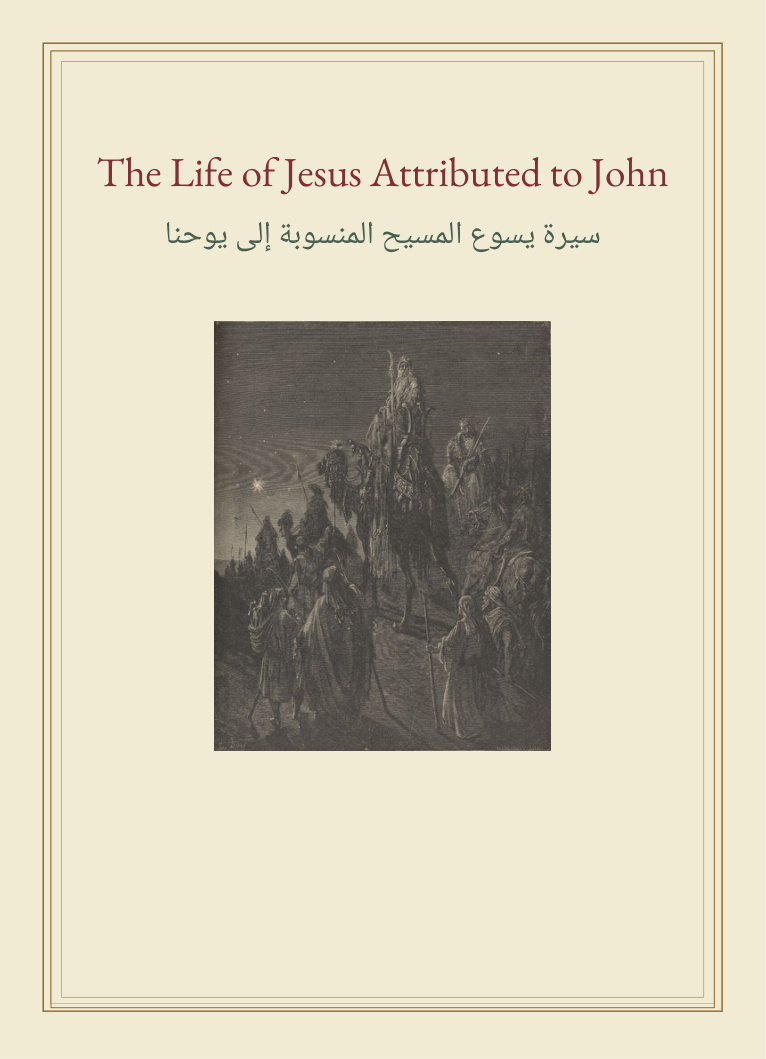
Cover. Gustave Doré (1832–1883), The Star in the East. Engraving after his drawing, The Doré ↗ Gallery of Bible Illustrations. Source: Project Gutenberg.
Arabic section · passage 1. Saint Catherine’s Monastery, Sinai Arabic 441. Library ↗ of Congress microfilm, view 4.
Translation · passage 2. Gustave Doré (1832–1883), The Murder of Abel. Engraving after his drawing, The Doré Gallery of Bible Illustrations. Source: Project Gutenberg.
Translation · passage 3. Gustave Doré (1832–1883), The Ascension. Engraving after his drawing, The ↗ Doré Gallery of Bible Illustrations. Source: Project Gutenberg.
Arabic section · passage 4. Gustave Doré (1832–1883), The Nativity. Engraving after his drawing, The ↗ Doré Gallery of Bible Illustrations. Source: Project Gutenberg.
Translation · passage 6. Gustave Doré (1832–1883), The Flight into Egypt. Engraving after his drawing, The Doré Gallery of Bible Illustrations. Source: Project Gutenberg.
Translation · passage 9. Gustave Doré (1832–1883), Jesus and the Woman Accused of Adultery. Engraving ↗ after his drawing, The Doré Gallery of Bible Illustrations. Source: Project Gutenberg.
Arabic section · passage 15. Gustave Doré (1832–1883), The Raising of Lazarus. Engraving after ↗ his drawing, The Doré Gallery of Bible Illustrations. Source: Project Gutenberg.
Translation · passage 21. Gustave Doré (1832–1883), The Last Supper. Engraving after his drawing, The ↗ Doré Gallery of Bible Illustrations. Source: Project Gutenberg.
Explanatory notes · passage 23. Saint Catherine’s Monastery, Sinai Arabic 441. Library ↗ of Congress microfilm, view 122.