
INTRODUCTION
The calendar of the ancient Arabs had already existed in the Arabian Peninsula for centuries before the arrival of Islam. It is obviously this calendar that the Quran refers to when it speaks of the month of Ramadan or the four sacred months of Hajj, since it was the calendar in use when the Quran was revealed. The calendar of the ancient Arabs was lunisolar: its months were determined by the moon, but it was tied to the sun’s cycle through the regular addition of intercalary months. Since the two cycles of the sun and moon do not coincide—a complete revolution of the earth around the sun takes 365 days, while twelve lunar months amount to about 354 days—the ancient Arabs took inspiration from the Israelites, who had themselves taken inspiration from the Babylonians, borrowing the practice of adding an intercalary month. For the ancient Arabs, the advantage of a calendar synchronised with the seasons was that the months of Hajj would fall at roughly the same time each year. Otherwise, Hajj could fall in the intense summer heat, making it very difficult to bear and inconvenient for their affairs. Moreover, it is very difficult to organise the various events governing people’s lives far in advance with a calendar that shifts over time, given that most of these events are closely linked to the seasons. To keep their calendar synchronised with the seasons, the ancient Arabs therefore added a thirteenth, intercalary month whenever the seasonal drift became too great. They called it “Nassi”, while the Israelites called it “Veadar”.
THE METONIC CYCLE
Originally, the Jews used the ripeness of the barley, Aviv, to determine whether to add the thirteenth, intercalary month. If the barley was not ripe enough in Nisan (corresponding to March–April), the first month of the Hebrew calendar, a thirteenth month called Veadar (Second Adar) was inserted after the twelfth month (Adar). This practice is confirmed by the following quotation from Rabbi Gamaliel, who wrote to the Jewish communities of Babylonia around the year 100 CE: “ We inform you that the lambs are still too tender and the chickens too small; the grain is not ripe. It has therefore seemed good to me and to my colleagues in the Sanhedrin to add thirty days to this year. ”

The addition of the intercalary month in the Hebrew calendar continued to follow the rule of Aviv, and thus remained irregular, until the fourth century BCE. From that period, the Israelites decided to take inspiration from the Babylonians, who added the intercalary month regularly according to the Metonic cycle, named after the philosopher Meton of Athens, who had described this cycle in 433 BCE on the basis of Babylonian astronomical knowledge. The Babylonians had observed that every nineteen years the orbits of the sun and moon coincided almost perfectly, since nineteen tropical years are very close in length to 235 lunar months. As nineteen lunar years contain 228 months, it was therefore enough to add seven months at regular intervals over a nineteen-year period to keep the two cycles, solar and lunar, more or less synchronised. Consequently, from the fourth century BCE onwards, the Israelites adopted the regular addition of an intercalary month according to the Metonic cycle, adding it in years 3, 6, 8, 11, 14, 17 and 19.

According to the Metonic cycle, it takes nineteen years for the orbits of the sun and moon to coincide almost perfectly again
The only difference between the Jewish and Babylonian calendars was that the intercalary month in the Jewish calendar was always added in the same position, after the twelfth month, whereas in the Babylonian calendar it moved forward by one month in each so-called “embolismic” year (a year of thirteen months: the usual twelve months plus the intercalary month). For example, if the intercalary month was added after Nisannu in one embolismic year, in the next embolismic year it was added after the following month, Ayyaru, and so on.

Notice how closely the names of the months in the Babylonian calendar resemble those in the Hebrew calendar, confirming that the Israelites took inspiration from the Babylonians.
THE CALENDAR OF THE ANCIENT ARABS
The ancient Arabs were strongly influenced by the Jews, who notably had a substantial presence within their aristocracy. Abu Maʿshar recounts that the ancient Arabs took inspiration from the Jews, adopting their Metonic cycle for adding intercalary months. From 358 CE, however, conflicts began to arise between the two communities, and the Arabs wanted to distinguish themselves from the Jews by introducing their own rules. The ancient Arabs kept the Metonic cycle of adding seven intercalary months over nineteen years in order to keep their calendar synchronised with the seasons. The difference was that the additions no longer followed a fixed rule, but were now decided by the Banu Kinanah tribe. They decreed when an addition should take place according to the weather and purely military, political and economic considerations. Since the Metonic cycle was respected, however, the calendar of the ancient Arabs remained synchronised with the seasons. This can be seen in its month names, which are clearly connected with the seasons.
- Muharram (sacred month): the third month of the “Greater Hajj” (which takes place in winter and spans three months).
- Safar (empty month): the ancient Arabs’ houses were generally empty during this month, because it was traditionally when their trading caravans travelled towards Syria and Yemen.
- Rabiʿ al-awwal (first spring)
- Rabiʿ al-thani (second spring)
- Jumada al-awwal (first month of drought)
- Jumada al-thaniyah (second month of drought)
- Rajab (“revered month” in the Semitic sense or “month of respect” in the Arabic sense) : the month of the “Lesser Hajj” (which takes place in summer and lasts only one month).
- Shaʿban (month of division/dispersal): the ancient Arabs dispersed in search of water, because this month corresponds to the end of summer and thus the peak of the dry season, when water was scarcer.
- Ramadan (month of light rains or intense heat): a month corresponding to the end of summer and the arrival of the first light autumn rains. A month of fasting for the ancient Arabs.
- Shawwal (month of drying up): originally, this month was the hunting month for the ancient Arabs. Etymologically, this month’s name refers to she-camels giving birth during this period and consequently becoming thinner because they are nursing.
- Dhu al-Qaʿdah (month of rest): the first month of the “Greater Hajj”. The ancient Arabs generally stayed at home during it to prepare for the peak Hajj season.
- Dhu al-Hijjah (month of pilgrimage): the second month of the “Greater Hajj”, corresponding to its high season and peak, since it falls in the very middle of the three-month period.
Thanks to the lunisolar calendar, the three months of the Greater Hajj and the month of Ramadan always fell during the best part of the year in terms of weather. For the Greater Hajj, this means the winter season, when the weather is mild throughout the Arabian Peninsula. Ramadan comes just after summer and at the beginning of autumn, when temperatures finally become bearable and the first autumn rains bring cooler weather. Moreover, this period corresponds to the autumn equinox, when temperatures are moderate everywhere on earth and day and night are roughly equal in length.

Around the autumn equinox, the length of the day ranges from ten hours in regions near the North Pole (for example, Murmansk in Russia) to about thirteen hours in regions near the South Pole (for example, Ushuaia in Argentina). The difference between the part of the world with the longest day and the part with the shortest is therefore small. Moreover, during this period, temperatures are moderate everywhere on earth, making it the ideal time for fasting.
THE ABERRATION OF THE PURELY LUNAR ISLAMIC HIJRI CALENDAR
The calendar’s origins go back to antiquity, and any calendar worthy of the name must allow the long-term planning of the various events that govern people’s lives, whether agricultural, social or religious. Since these events are generally linked to the seasons, a calendar not tied to the seasons is simply unusable. All the calendars people have used until now were tied to the seasons: those of the ancient Arabs, Israelites, Romans, Egyptians, Babylonians and Mesopotamians, as well as the Julian calendar and its successor, the Gregorian calendar we use today. This is not true of the purely lunar Islamic Hijri calendar, however. It is based solely on the moon’s cycle, with no connection to the sun’s, making it unusable in everyday life and explaining why Muslims use it only to determine the dates of their religious events.
Consequently, the Islamic calendar based on observing the new moon is used in contemporary Muslim societies only to determine dates associated with religious celebrations. For all their other needs, Muslims around the world have used solar calendars for roughly two centuries : the Gregorian or Persian calendar, based on astronomical calculations.
Source: https://fr.wikipedia.org/wiki/Calendrier_h%C3%A9girien
The Muslims’ removal of the intercalary month is therefore an aberration, because every calendar, whether lunisolar or based on astronomical calculation, necessarily needs the regular addition of intercalary months or days to remain synchronised with the seasons. As we have seen, lunisolar calendars require seven intercalary months to be added over nineteen years, known as the Metonic cycle. The Gregorian calendar, by contrast, is a solar calendar based on astronomical calculation and requires an intercalary day every four years, in leap years.
THE JULIAN AND GREGORIAN CALENDARS

Let us examine the Julian and Gregorian calendars in detail to understand why any calendar worthy of the name absolutely needs to add intercalary periods regularly to remain synchronised with the seasons. The Julian calendar, adopted by the Roman emperor Julius Caesar in 46 BCE, remained in use throughout the Christian world until 15 October 1582, when it was replaced by the Gregorian calendar. The Julian calendar is based on aligning the months with the seasons so that 21 March always corresponds to the spring equinox and the year begins eleven days after the winter solstice. This corresponds to a year length of 365.2422 days. To obtain a whole number of days, the year is taken to last 365 days, and every four years an intercalary day, 29 February, is added to compensate for the difference of 0.2422 days. However, a small difference remains between 365.25 days, the average Julian calendar year, and 365.2422 days, the actual length of a tropical year, corresponding to the time it takes the earth to return to the same configuration relative to the sun. This difference averages eleven minutes a year and accumulates to one day every 130 years. Over the centuries, it had reached ten days by 1582. As a result, the spring equinox that year occurred on 11 March rather than 21 March, as it normally should have done.
To make up for this delay, Pope Gregory XIII decreed that Thursday 4 October 1582 would be followed by Friday 15 October 1582. He also made adjustments to the Julian calendar to prevent the error from recurring, giving rise to the Gregorian calendar used throughout the world today. This calendar retains leap years for all years divisible by four (2004, 2008, 2012…), including those divisible by 400 (1600, 2000, 2400…). Century years divisible by 100 but not by 400, however, such as 1700, 1800, 1900, 2100 and 2200, are no longer leap years. With these adjustments, the average Gregorian year is 365.2425 days long, very close to the tropical year’s 365.2422 days. The Gregorian year is about twenty-seven seconds longer than the tropical year, so one day must be removed from the calendar every 3,223 years—a very small discrepancy.

On 15 October 1582, Pope Gregory XIII decided to switch from the Julian to the Gregorian calendar throughout the Christian world. The Muslim world should also have taken inspiration from this sensible decision by adopting a calendar worthy of the name: one aligned with the celestial bodies and allowing its populations’ social and religious lives to be organised. But the Muslim world has long been out of step with the rest of the world, hence its considerable backwardness in every field.
Whatever the type of calendar, we can therefore see that adding intercalary months or days is essential. Otherwise, a calendar could no longer fulfil its function: planning periodic natural phenomena and the social and religious events of people’s lives far in advance. Removing the intercalary month from their calendar is therefore a complete aberration, and Muslims today are the only people in the world to use a purely lunar calendar for their religious rites. Not only can Muslims not use their calendar in everyday life, being obliged to use the Gregorian calendar instead, but they do not obey God’s prescription, observing the Ramadan fast and Hajj at inappropriate times, which makes their practice as arduous as it is ineffective.
THE QURAN CONDEMNS NASSI, NOT THE INTERCALARY MONTH!
Muslims justify removing the intercalary month, and thus adopting the purely lunar Hijri calendar, on the basis of two Quranic verses. Here is the first:
Nassi constitutes an increase in impiety by which those who have disbelieved go astray: they declare it profane one year and sacred another, to arrive at the same number of months that God has declared sacred, thus making profane what God has declared sacred. The evil of their deeds has been made attractive to them. And God does not guide disbelieving people!
S9:V37

The Nassi ( ٱلنَّسِىٓءُ) is generally translated by Muslims as the month of “forgetting”, to signify that the thirteenth, intercalary month was a fictitious month that served only to adjust the calendar and therefore had to be forgotten. Yet this term does not come from Arabic, but was borrowed from Hebrew and means “prince”, the title given to the head of the Sanhedrin, who held the authority to decide whether the Jews should add an intercalary month. Nassi therefore does not at all mean a month that must be forgotten, as Muslims conveniently interpret it—to the point of removing it altogether from their calendar. Rather, the term refers to the body responsible for adding this month: in the case of the ancient Arabs, the Banu Kinanah tribe. What this verse condemns is therefore not the intercalary month itself, but Nassi as such, which the ancient Arabs added as they pleased. Whereas the Jews and Babylonians added their intercalary month when it was truly necessary and according to precise rules, the ancient Arabs used it to change the timing of Hajj to suit their economic interests and to impose or lift the military truce, given that warfare was forbidden during the sacred months. By choosing to insert the month of Nassi at any time of year and declaring it profane or sacred as they wished, they could thus make any month of the year sacred or profane. This was where the “increase in impiety” mentioned in this verse lay.
In the lunisolar calendar of the ancient Arabs, an ordinary year lasts twelve months, and adding an intercalary month does not contradict this in any way. The Muslims’ interpretation of the second verse below, on which they base their justification for removing the intercalary month, is therefore not correct.
The number of months with God is twelve, according to God’s decree on the day He created the heavens and the earth. Four of them are sacred. Such is the upright religion. Do not wrong yourselves during them, and fight the idolaters without exception, just as they fight you without exception. And know that God is with the pious.
S9:V36
The decision to remove the intercalary month was not taken by the Prophet Muhammad. Even Muslims agree that its removal did not take effect until well after his death, which tends to confirm that he never actually made this decision.
THE TRUE CALENDAR ACCORDING TO THE QURAN IS LUNISOLAR

According to Islamic beliefs, it was supposedly the Prophet Muhammad himself who ordered the removal of the intercalary month in the ninth year of the Hijra, following the revelation of the verse we have just examined.
Creation of the Islamic calendar
Departing from Jewish practice, the Quran expressly prohibits the intercalary month.
The intercalary month is said to have been abolished at the end of the Medinan period, at the end of year 9 of the Islamic calendar, during a public proclamation at the pilgrimage, and it is mentioned once in the Quran:
“ The number of months before God is twelve, as it is in God’s book, since the day He created the heavens and the earth. Four of these months are sacred; this is the constant belief.”
Year I of this calendar began on the first day of the Hijra, 1 Muharram (15 or CE, according to theological writers). The first epoch is called “astronomical”, the second “civil”. This calendar was adopted ten years after that event.
Source: https://fr.wikipedia.org/wiki/Calendrier_h%C3%A9girien
But this cannot be true, because “Ramadan” is not a proper name: it denotes a very specific season, corresponding to the end of summer and the beginning of the rains preceding autumn.
رمضي: ما كان في آخر الصيف وأوَّلِ الخريف
Ramadhyou: that which is at the end of summer and the beginning of autumn
الرَّمَضُ : المَطَر يأتي قُبُلَ الخريف
Al-Ramadhou: rain preceding autumn
https://www.almaany.com
The month of Ramadan can therefore never fall in a season that does not correspond to the definition of its name, as happens with the purely lunar Islamic Hijri calendar. That would mean that the Quran, which explicitly mentions the month of Ramadan, uses an inappropriate term. Yet falsehood cannot enter the Quran, either in the future or in the past.
Falsehood cannot enter it, either in the future or in the past. A revelation from the Most Wise, Worthy of praise.
S41:V42
In reality, the Quranic verse stating that a year contains twelve months is in no way a divine command to remove the intercalary month. It merely informs us of an astronomical reality: the year is divided into twelve distinct periods of time, corresponding to the twelve constellations through which the sun and planets pass during the year.

Each month corresponds to a constellation through which the sun and planets pass, and there are twelve of them.
Furthermore, the fact that a tropical year lasts 365.2422 days and the average lunation lasts 29.53 days means that there are, on average, 12.36827 lunations per tropical year. A tropical year therefore contains twelve complete lunations, corresponding to the twelve months per year mentioned in this verse. The intercalary month serves only to make up for the shortfall of 0.36827 of a lunation that accumulates over the years. As soon as this shortfall exceeds one month, an intercalary month must be added to make up for it. Whatever the calendar, we have to add intercalary days or months because the ratio between the sun’s cycle and the moon’s cycle is not a whole number, whereas we measure time only in whole numbers. We must therefore compensate for the missing fractions by adding a day or a month, depending on the type of calendar, when the accumulated difference becomes too great.
Since the astronomical phenomena presented above are independent, the units they define are not commensurable: their ratio is not a whole number.
In our era, a year is 365.242201 days long; the average lunation lasts 29 days, 12 hours, 44 minutes and 2.8 seconds (29.53 days); a solar year contains 12.36827 lunations.
Faced with this difficulty, peoples have chosen either to let the calendar fall out of synchronisation (the choice made for the Hijri calendar) or to realign it empirically with celestial phenomena (lunisolar and solar calendars), even at the cost of losing the continuity of days. A calendar is then described as predominantly arithmetic or predominantly astronomical.
source: https://fr.wikipedia.org/wiki/Calendrier

A lunation is the time the moon takes to return to the same position relative to the sun.
The purely lunar Islamic Hijri calendar cannot possibly have been prescribed by God, because the Quran clearly states that both the sun and moon are essential for measuring time, whereas the Islamic calendar uses only the moon.
Cleaver of the dawn, He made the night a period of rest, and the sun and moon a means of measuring time. Such is the natural order of things, as decreed by the Almighty, the All-Knowing.
S6:V96
Human beings do not know how to make a perpetual clock, because every clock inevitably loses its accuracy over time. That is why God assigned the sun and moon a perpetual revolution, so that they serve as a cosmic clock, allowing people to measure time simply and accurately.
And for you, He subjected the sun and moon to perpetual revolution. And He made the night and day subject to you.
S14:V33

It is no coincidence that the sun and moon are often associated with clocks: both are essential for measuring time.
The sun and moon each perform a different role: the moon, through its phases, shows where we are in the current month and divides the year into months, while the sun keeps the calendar synchronised with the seasons.
And they ask you about the phases of the moon. Say: “They serve to indicate time for people, and also for Hajj.” […]
S2:V189
The speed and movement of the sun and moon were determined with meticulous care by God, showing that there is a right time for every event. Observing the Ramadan fast and Hajj at any time of year, as happens with the purely lunar Islamic Hijri calendar, is therefore not the same as observing them at the time determined by God. This has serious consequences for Muslims, but in their misguidance they do not realise it.
The sun and moon move according to a meticulous calculation.
S55:V5
Neither can the sun catch up with the moon nor the moon with the sun, since each travels along its own orbit, like two runners each running on a different track: neither will ever be able to catch up with the other.
The sun cannot catch up with the moon, nor can night precede day; each travels along its own orbit.
S36:V40
The sun and moon are connected like the two hands of a watch. However, it is the sun that determines the overall movement of the other celestial bodies, not the reverse, which means that the moon’s movement is determined by the sun’s.
By the sun and its brightness! And by the moon when it follows it !
S91:V1-2
It is the sun that determines the seasons, not the moon. That is why the moon’s cycle must conform to the sun’s through the regular addition of intercalary months.

Both the sun and moon are necessary for measuring time, hence the absolute need for a lunisolar calendar. Unlike Muslims, Jews have retained the intercalary month in their calendar to this day, enabling them to observe their religious celebrations on the correct dates set by God.
To yield their full benefits and comply with the divine prescription, the Ramadan fast and the four sacred months of Hajj must be observed according to the lunisolar calendar of the ancient Arabs at the time the Quran was revealed, not according to the purely lunar Islamic Hijri calendar, which appeared only much later. The only correction the Quran made to the ancient Arabs’ calendar was to say that adding an intercalary month had to be justified by the need to correct seasonal drift, rather than done arbitrarily to influence truces or the timing of Hajj.

The Metonic cycle consists of adding seven intercalary months over nineteen years, which amounts to adding an intercalary month every thirty-two months.
Here is the lunisolar calendar calculated from the time of the Prophet Muhammad, before the intercalary month was abolished, up to the present day. This is therefore the calendar believers must use to determine the period of Hajj and the month of Ramadan.
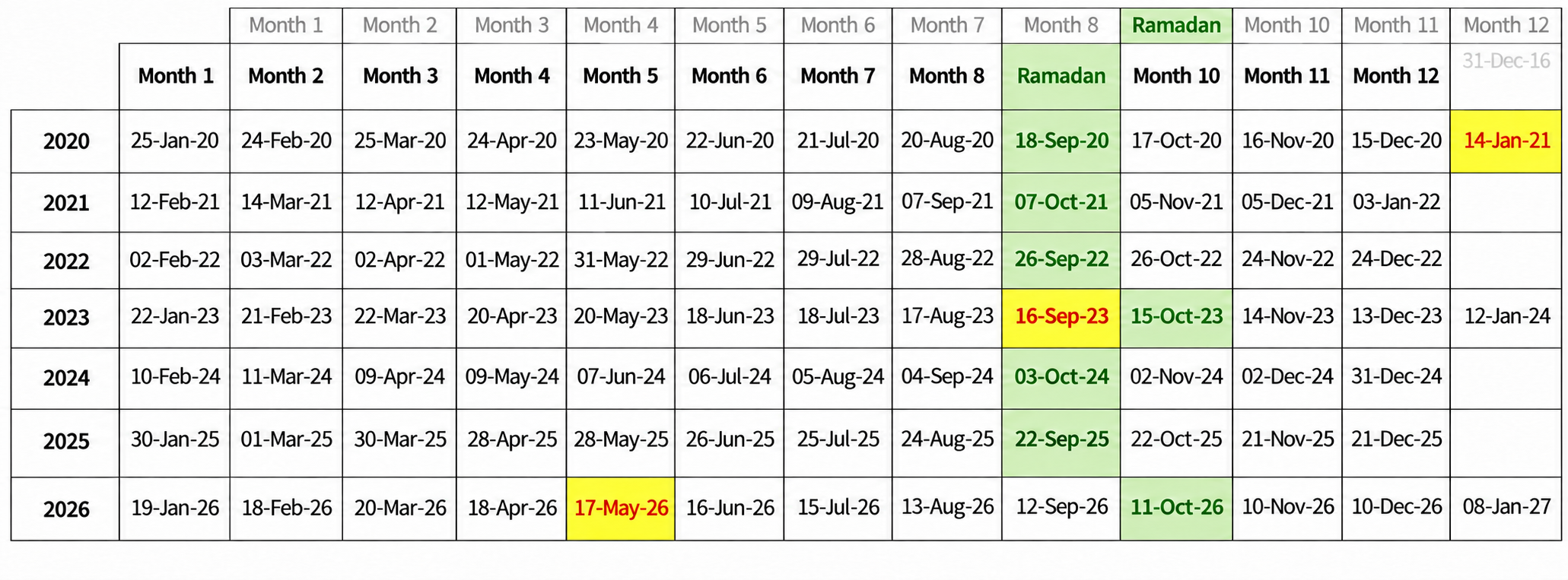
Green marks the month of Ramadan according to the lunisolar calendar prescribed by the Quran; yellow marks the intercalary months that keep the calendar synchronised with the seasons.
As you can see, the month of Ramadan always falls at roughly the same time of year: just after summer and at the beginning of autumn, when temperatures are mild and the length of the day is balanced almost everywhere on earth, making it the ideal time for fasting.
THE QUMRAN MANUSCRIPTS CONFIRM THE LUNISOLAR CALENDAR

The Qumran manuscripts were discovered near the ruins of Qumran between 1947 and 1956, in eleven different caves. In total, 870 manuscripts were reconstructed from tens of thousands of fragments. Most were written on parchment and around a hundred on papyrus. Slightly fewer than 15% are written in Aramaic, the country’s everyday language since the Persian occupation, but the vast majority are in Hebrew, the literary and doctrinal language regarded as “holy”, in which the original Torah was written.
The Qumran Manuscripts, or Dead Sea Scrolls are considered the greatest archaeological discovery of the century and contain the oldest Hebrew texts of the Old Testament found so far. Among the reconstructed fragments is an excerpt from the Book of Genesis clearly stating that a year according to God corresponds to the tropical year—365 days (estimated at 364 days at the time)—not the lunar year, which lasts only 354 days. This shows that the calendar according to God has never changed since the beginning of time and consists in using both the sun and moon to measure time.
During the six hundred and first year of Noah’s life, on the seventeenth day of the second month, a Sunday, the earth was dry. On that day, Noah left the ark exactly at the end of a year, after three hundred and sixty-four days […] to the very day, after a full year.
Source: Qumran Manuscripts, REF 4Q252, Frag. 1, Col. 2

The eleven Qumran caves are in the West Bank desert
THE PROPHET MUHAMMAD NEVER ABOLISHED THE INTERCALARY MONTH
A recent study by Islamic studies scholar Wissem-Eddine Ishak, whose findings were published in 2018 in a work entitled “The Book of the Intercalary Month’s Innocence” (كتاب براءة النسيء), presented several pieces of historical evidence demonstrating conclusively that the Prophet Muhammad was never responsible for abolishing the intercalary month. One of the most indisputable pieces of evidence emerges when the dates of the Battle of Badr and the Battle of Yarmoukare compared in both the Hijri and Julian calendars then in use.
Note: the Hijri calendar—the ancient Arabs’ lunisolar calendar with an intercalary month, but with its year zero fixed at the Hijra, the date of the Prophet Muhammad’s migration to Medina—must not be confused with the purely lunar Islamic Hijri calendar without an intercalary month, which was introduced only well after the Prophet’s death.
THE BATTLE OF BADR

The Battle of Badr, an illumination from the Siyar-I Nabi, circa 1595. Topkapi Imperial Museum in Istanbul.
According to official Muslim sources, the Battle of Badr is said to have taken place on 17 Ramadan in the year 2 AH, thus well before the supposed abolition of the intercalary month. These same sources equate this date with 13 March 624 in the Julian calendar, but this cannot be the correct date, for at least three reasons:
- Before the intercalary month was abolished, the months of the Hijri calendar were still synchronised with the seasons. Ramadan was therefore supposed to fall around September or October, so 13 March cannot be the correct date.
- Muslim historians did not take the intercalary month into account in the calculations that led them to this date. Yet in the year 2 AH, the intercalary month had not yet been removed from the calendar; it was removed at least seven years later, in the year 9 AH, or even later, during Omar’s reign, according to other Muslim sources.
- This estimate does not take into account the transition from the Julian to the Gregorian calendar, when the date changed overnight from 4 October 1582 to 15 October 1582, creating an additional ten-day difference that must also be taken into account in the calculations.
Taking the above observations into account and using a NASA database of lunar cycles dating back to 2000 BCE, Wissem-Eddine Ishak estimated that 17 Ramadan 2 AH would instead correspond to 16 October 623 in the Julian calendar.
The English Wikipedia page on the Battle of Badr retained the old, incorrect date of 13 March 624, whereas the French page adopted the new, corrected date, namely 16 October 623.

This difference in dates illustrates the uncertainty surrounding the removal of the intercalary month from the Hijri calendar. Since the Prophet Muhammad never actually ordered its removal, Muslim historians therefore had to find a way to claim otherwise, by saying that it was abolished during the Prophet’s lifetime, in the ninth year of the Hijra, but was only made official during Caliph Omar’s reign. This is obviously a lie invented by Muslims, because if the Prophet had actually given this order, it would have been carried out immediately, since the order comes directly from God.
With the corrected date of the Battle of Badr, 16 October 623, Ramadan would begin around 30 September 623, which is the right time of year and indicates that this is the date we should use for the battle.
Since I published the very first version of this article several years ago, the date of the Battle of Badr on the French Wikipedia page has been changed, and Muslims have reverted to the old, incorrect date of 13 March 623 so that the same date appears everywhere. Muslims prefer to retain a date they know perfectly well is false in order to conform to the official account, rather than acknowledge the truth. For all Muslims agree that in the year 2 AH, the Hijri calendar still followed the seasons, yet they have no problem placing Ramadan in the middle of March. This shows that what interests them is not the truth or God’s way, but only perpetuating the way of their ancestors and maintaining the cohesion of their community.

As you can see, the date has been changed in the meantime, which means that Muslim authorities are aware of their inconsistencies and are trying to hide the truth, even if that means making statements that are clearly false.
THE BATTLE OF YARMOUK

Illustration of the Battle of Yarmouk by an illustrator who was an anonymous Catalan (c. 1310–1325).
The Battle of Yarmouk was one of the major battles of the early Islamic era and marked the first great wave of Muslim conquests. It was fought early in the reign of the 2nd caliph, Omar, against the armies of the Eastern Roman Empire, and ended Byzantine rule in Syria. What distinguishes this battle is that its date is recorded in both Muslim and Byzantine (Syriac) sources. Historians date its beginning to 5 Rajab in the year 15 AH, approximately thirteen years after the Battle of Badr and six years after the supposed abolition of the intercalary month by the Prophet Muhammad (in the year 9 AH). Byzantine-Syriac sources place the beginning of this battle on 15 August 636 in the Julian calendar, which means that Ramadan in the same year would have begun around 9 October 636. Indeed, between 5 Rajab and 1 Ramadan, there are approximately fifty-five days, if we assume that Rajab and Shaʿban each have thirty days; adding fifty-five days to 15 August brings us to 9 October.

Yarmouk Valley. The authors of this article are independent historians committed to renewing the study of history. They have taken an interest in many historical periods and, in particular, have undertaken extensive studies of the Muslim world.
The date of 9 October for the beginning of Ramadan therefore indicates that in the year 15 AH, six years after the supposed removal of the intercalary month by the Prophet Muhammad, it was still in use, since Ramadan falls at the right time of year. If, as some Muslims claim, the intercalary month had been removed as early as the year 9 AH, Ramadan in the year 15 AH would have fallen around August, rather than in October as documented by the Byzantines.
This therefore shows beyond dispute that the Prophet Muhammad never removed the intercalary month during his lifetime, now that we have conclusive proof that in the year 15 AH, four years after the Prophet’s death, the intercalary month was still in use. Nor can we accept the explanation that this prohibition only took effect during Caliph Omar’s reign, since the orders of the Prophet, and therefore of God, must be carried out immediately.
All the evidence indicates that this removal actually took place not during Omar’s reign, but during that of the fifth caliph, Muawiya, who, wishing to establish an Islamic empire like the other great empires, wanted to create his own calendar by removing the intercalary month. Many other innovations were introduced during his reign, since he permitted the use of hadiths, which had previously been forbidden, and commissioned the fabrication of a great many of them in order to exert greater control over people’s lives and make Islam a state religion. These innovations also included reducing the duration of the Hajj from four months to just ten days and ending the military truce during the sacred months.

Umayyad Caliph Walid 1st
In the supplications of Ali Zayn al-Abidin, known as al-Sajjad (the one who prostrates), grandson of the fourth so-called “rightly guided” caliph, Ali, the Prophet Muhammad’s cousin and son-in-law, we can read the following in the forty-fifth supplication of the Psalms of Sajjad (الصحيفة السجدية), entitled “Bidding Farewell to the Month of Ramadan”:
O God! We are the people of this month, through which You have honoured us and to which You have guided us by Your grace, while the wretched have been ignorant of its date and, in their wretchedness, have forbidden its blessings. We owe our knowledge of it to You; You have guided us in observing it properly, and by Your grace we have fasted and observed it, though with shortcomings and neglect. Of so much, we have accomplished so little!
اللهم إنا اهل هذا الشهر الذي شرفتنا به ، و وفقتنا بمنك له حين جهل الاشقياء وقته ، و حرموا لشقائهم فضله .أنت ولي ما اثرتنا به من معرفته ، و هديتنا له من سنته ، و قد تولينا بتوفيقك صيامه و قيامه علي تقصير ، و ادينا فيه قليلا من كثير
In this supplication, Imam Ali Zayn al-Abidin, the only one of Hussein ibn Ali’s children to survive the Battle of Karbala, blames the wretched who were ignorant of Ramadan’s true date. These “wretched” people to whom al-Sajjad refers are the Umayyad caliphs, who removed the intercalary month by introducing the purely lunar Hijri calendar, thereby shifting the true dates of the various rites prescribed by God, such as the Hajj and the Ramadan fast. This departure from God’s true calendar reflects Muslims’ collective departure from God’s true way, since Muslims had already begun to stray from God’s precepts as early as Caliph Muawiya’s time, which explains why God allowed them to go astray.
CONCLUSION
God established the true calendar and prescribed a time for everything, and altering God’s rules inevitably has disastrous consequences, which we can see among Muslims today. The fact that Ramadan can fall at any time of year makes its observance very difficult, especially when it falls in the height of summer, when the heat is stifling and the days are extremely long. Moreover, it disrupts the summer holidays, which are clearly meant for rest, not fasting. Conversely, when it falls in the middle of winter, there is no point in fasting, since the days are extremely short. God prescribed fasting at the start of the school year, because that is when the year truly begins, once the summer rest is over and people have returned home. As for the Hajj, the fact that it can fall at any time of year and now lasts only ten days, instead of the four months originally intended by God, makes it unbearable when it falls in the height of summer. Every year, thousands die because of the heat and the crowds, quite apart from its exorbitant cost. The purely lunar Islamic Hijri calendar thus illustrates the full extent of the discrepancy between Islamic practice and that of the Quran, but this does not seem to trouble Muslims at all, since they stopped attaching any importance to the truth long ago. All that matters to them is perpetuating their ancestors’ beliefs and remaining within their community at all costs.