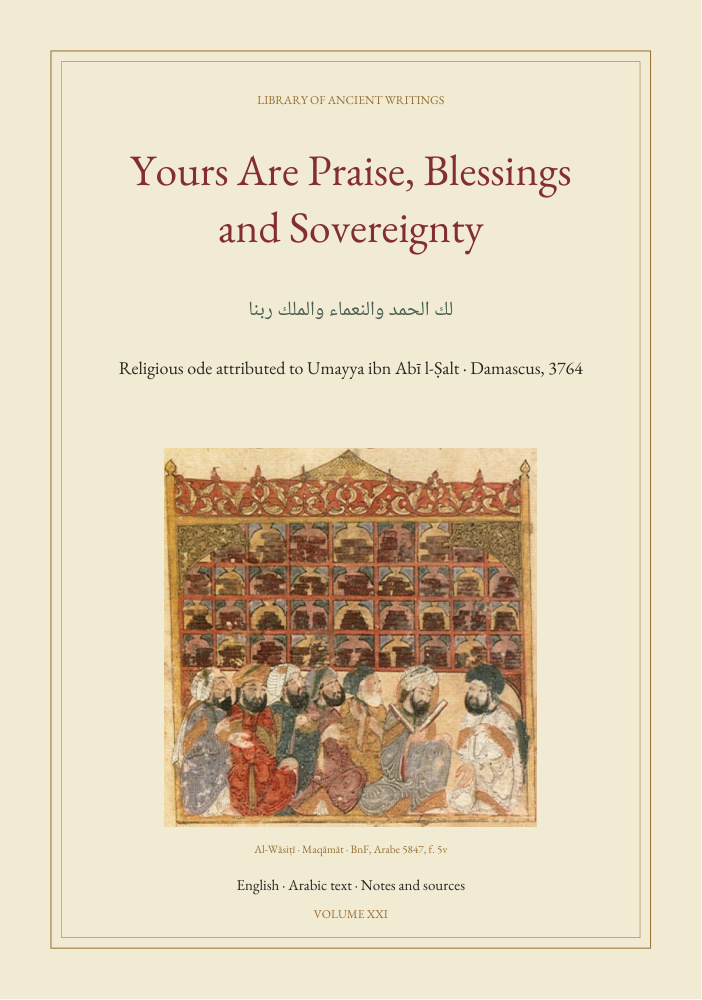
Yours Are Praise, Blessings and Sovereignty
The ode opens with praise of the King and a vision of the angels surrounding the Throne. Its fifty-six verses move from heaven to human consciousness and the passage of time. The refusal to prostrate before Adam leads to the final scene, in which the adversary is consigned to the Fire.
Sources and method of compilation
Historical context
Dating
Umayya ibn Abī l-Ṣalt lived in Muḥammad’s time. Transmitters place the ode at the beginning of the prophetic mission, but neither its attribution nor its date of composition is certain. The Damascus copy is medieval.
Origin and preservation
Tradition connects the ode with the poet of Ṭāʾif. The al-Ẓāhiriyya Library in Damascus preserves it in miscellany 3764, item 6.
How the volume was compiled
The heading in the Damascus copy announces a poem by Umayya ibn Abī l-Ṣalt about Islam and Muḥammad’s mission, followed by other accounts. The formula آخر القصيدة, “end of the poem”, marks the boundary of the piece. The audition records and the transmitter’s prose framing it belong to the transmission of the fascicle.
Umayya is a poet of Ṭāʾif contemporary with Muḥammad. At the beginning of the text, transmitters place the poem at the start of the prophetic mission. This assertion was recorded much later. The university’s poetry volume classifies the piece under the heading “attributed to Umayya”. The 56 verses cannot be dated with certainty to the poet’s lifetime. The physical copy is medieval.
Verses 23–26 contain echoes particularly close to surah 112. Verses 47–52 return to the refusal to prostrate before Adam, also found notably in Quran 7:11–13 and 38:71–76. These parallels shed light on the transmitted text without settling its origin.
In verse 1, the edition gives جِدًّا while other readings have مَجْدًا , “in glory”. In verse 9, the edition has أمين لوحي القدس, “custodian of the holy revelation”. Other copies give أميناه روح القدس, “His two custodians, the Holy Spirit…”. In verse 56, the Damascus copy and the edition offer different expressions to evoke the helplessness of the one who burns. The French follows the edition in all three passages.
Several printed texts of the ode exist, and verses circulated in historical works. The value of the Damascus manuscript lies in the separate transmission of the piece, with its opening and ending visible.
Damascus 3764, PDF images 59–62. The end of the poem is indicated on the left of image ↗ 62
Umm al-Qurā University, base text in 56 verses, no. 121 in the collection, p. 673 ↗
Ibn al-Jawzī’s Muntaẓam, another transmission of the same piece, with its variants
Nicolai Sinai, study of the corpus’s authenticity and of another poem, that of the ↗ Thamūd
Sources and references
Image provenance
Damascus, al-Ẓāhiriyya, miscellany 3764, item 6, image 60. ↗