The Didache
The Teaching of the Twelve Apostles
The Didache is a short Christian manual on conduct in life, baptism, fasting, prayer, the communal meal and the reception of travelling teachers. Its Greek title means ‘teaching’. The expanded title transmitted by the manuscript is: ‘The Lord’s teaching conveyed to the nations through the twelve apostles’.
This volume presents the sixteen surviving chapters through their final sentence. Each chapter is immediately followed by its Translation Choices. The illustrations reproduce older works of art; the ten final plates allow readers to consult the pages of the Jerusalem manuscript in the reproduction published in 1887.
Sources and method of compilation
How the volume was compiled
The text adopted
The French translation underlying this English edition principally follows the Greek text published by J. Rendel Harris in 1887, with his photographic reproductions of the Jerusalem manuscript, Panagiou Taphou 54, often abbreviated H54. A witness (a manuscript or early edition transmitting the text) shows which formulations have actually come down to us. Comparing these documents helps establish the text; it does not by itself confirm the historical reality of everything a work recounts. [HARRIS1887]
The edition and French translation by Hemmer, Oger and Laurent, published in 1907, provide a comparison for linguistic difficulties and proposed corrections. The numbering in sixteen chapters and one hundred paragraphs is retained. The short titles in the reading contents are editorial guides; they replace no passage. [HEMMER1907]
Readable language, visible choices
The French text was revised sentence by sentence to avoid literal renderings that obscure the meaning. An idiomatic expression may be clarified where its scope can be identified: thus, a ‘girded’ garment becomes clothing tightened at the waist. Significant images are retained and explained. Parentheses in the translation provide only brief vocabulary clarifications. This English version follows that French text.
The Translation Choices follow each chapter. They distinguish a word’s possible meaning, a difference between two early formulations, and a correction proposed by an editor. The last is sometimes called a conjecture: it is then a reconstructed reading, not letters directly present in the manuscript. Relevant Greek forms appear with explanations translated from French.
Some passages remain obscure, notably XI.11 and XVI.5. An intelligible reading is adopted in the main text, then explicitly presented as an interpretation in the notes. Other serious readings are set out there. No claim of certainty replaces missing words or an unresolved difficulty.
Scope and presentation
The translation includes every paragraph of the adopted text. The final break at XVI.8 is respected. Prayers are translated in their own form, with their repetitions and differences, without being brought into line with a familiar liturgical formula. Thematic commentaries are replaced by only those explanations needed for the translation choices.
The illustrated works are later than the composition of the Didache. Their captions give their period and provenance: they accompany the reading without being presented as contemporary images of the earliest communities. Textual sources and full illustration credits appear at the end of the volume.
Sources and references
HARRIS1887. J. Rendel Harris, The Teaching of the Apostles, Baltimore, Johns Hopkins University, 1887.
Greek text, pages 1–10; commentary; plates I–X. Textual basis and facsimile used.
https://archive.org/details/cu31924029296114 ↗
HEMMER1907. H. Hemmer, G. Oger and A. Laurent, Les Pères apostoliques: Doctrine des Apôtres, Épître de Barnabé, Paris, Alphonse Picard et fils, 1907.
Early edition and translation used for comparison; linguistic notes and proposed corrections.
https://bkv.unifr.ch/fr/works/cpg-1753/versions/la-doctrine-des-douze-apotres-didache ↗
LAKE1912. Kirsopp Lake, The Apostolic Fathers, volume I, 1912, Greek text of the Didache, CCEL transcription.
Additional consultation. Errors and omissions in the electronic transcription, notably IX.2 and X.5, are not treated as manuscript variants.
https://www.ccel.org/l/lake/fathers/didache.htm ↗
The captions identify the reproduced works and their periods. The images accompany the text; they are not presented as contemporary depictions of the events recounted.
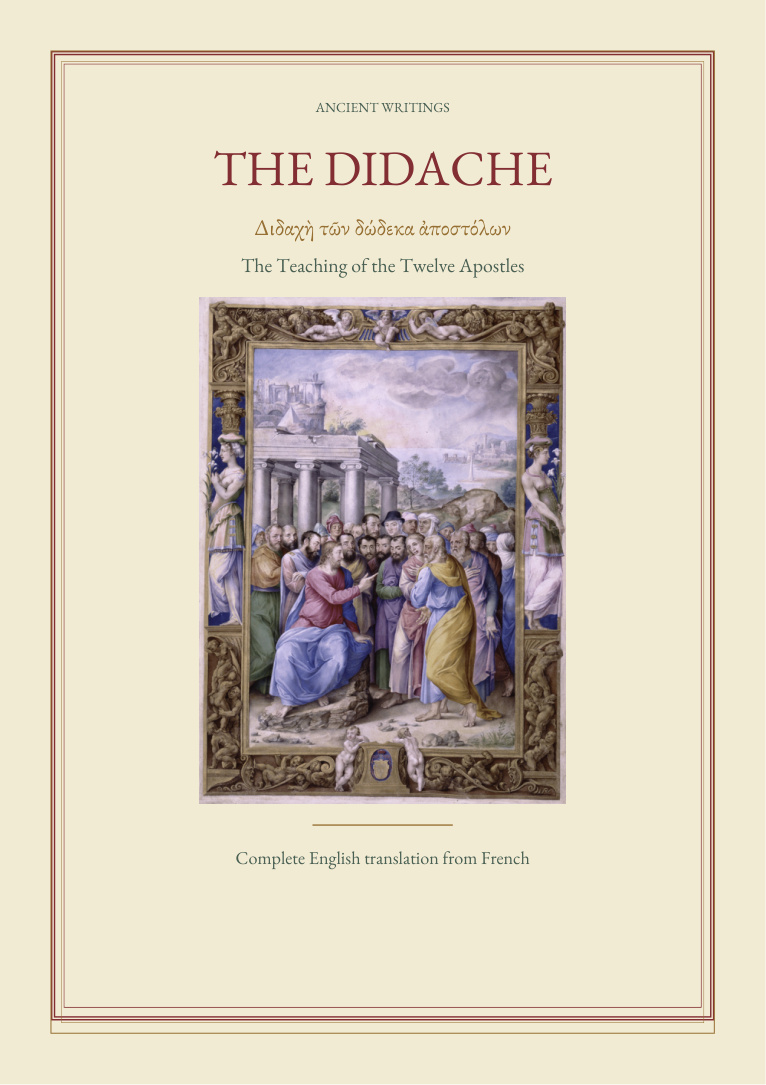
The Sermon on the Mount
Giulio Clovio (1498–1578), miniature from the Towneley Lectionary, c. 1550 according to the catalogue. NYPL, Manuscripts and Archives Division, MA 91 / MssCol 2557, fol. 6v, image 1610036. Public-domain reproduction supplied by the NYPL and distributed through Wikimedia Commons. The crop removes the modern photographic support and calibration chart; the miniature and its painted border are retained.
https://digitalcollections.nypl.org/items/510d47da-e645-a3d9-e040-e00a18064a99 ↗
Christ Teaching
Christ Teaching, c. 1000, tempera, gold leaf and ink on parchment, 30.8 × 20 cm. J. Paul Getty Museum, Ms. 9. Google Art Project reproduction distributed through Wikimedia Commons as a faithful photograph of a public-domain work (PD-Art). Image resized without altering its content.
https://commons.wikimedia.org/wiki/File:Christ_Teaching_-_Google_Art_Project.jpg ↗
Feeding the Hungry
Abraham Bosse, Feeding the Hungry, 1635; publisher Jean I Leblond. Etching and engraving, 25.8 × 32.6 cm. The Metropolitan Museum of Art, 26.49.15, Harris Brisbane Dick Fund, 1926. Open Access image, public domain. Reproduction resized.
https://www.metmuseum.org/art/collection/search/385967 ↗
The Baptism of Jesus
T’oros the Deacon, Baptism, one of Four miniatures of the life of Christ from a gospel book of 1311. Ink and pigments on paper. The Metropolitan Museum of Art, group 2020.142.1–.4, Purchase, Giorgi Family Foundation Gift, 2020. Open Access image, public domain. Leaf reproduced without retouching its content.
https://www.metmuseum.org/art/collection/search/751462 ↗
The Last Supper and the Washing of Feet
Manuscript Leaf with the Last Supper and the Washing of the Apostles’ Feet, from a Royal Psalter. England, c. 1250–1270; tempera and gold on parchment. The Metropolitan Museum of Art, 22.24.3, Rogers Fund, 1922. Open Access image, public domain. The scene is not presented as an original illustration of the Didache’s prayers.
https://www.metmuseum.org/art/collection/search/466370 ↗
Angels Restrain the Four Winds
Leaf from a Beatus Manuscript: Angels Restrain the Four Winds; the Angel Ascends from the Rising Sun. Spain, c. 1180; tempera, gold and ink on parchment. The Metropolitan Museum of Art, 1991.232.7. Purchase, The Cloisters Collection, Rogers and Harris Brisbane Dick Funds, and Joseph Pulitzer Bequest, 1991. Open Access image, public domain.
https://www.metmuseum.org/art/collection/search/466202 ↗
Cover: Giulio Clovio, Towneley Lectionary, c. 1550, fol. 6v. New York Public Library, MA 91. Renaissance illumination.