The Protoevangelium of James
Mary’s birth and childhood · Twenty-five chapters translated from French
This ancient narrative recounts Mary’s birth, her childhood consecrated to God, her betrothal to Joseph and the birth of Jesus. It ends with the coming of the Magi, Elizabeth’s flight and the murder of Zechariah. It traditionally bears James’s name, although this attribution does not establish the identity of its author.
Here the title ‘Protoevangelium’ means a narrative set before the events usually recounted at the beginning of the Gospels. The work belongs to Christian apocryphal literature: it is not part of the New Testament. Probably composed in the second century, it circulated in many languages. Papyrus Bodmer V, from the third–fourth centuries, preserves a very early Greek form.
This volume presents the twenty-five chapters of the form published and translated in the nineteenth century. After each chapter, a short section explains translation choices that may affect understanding. The older illustrations are identified and dated; they show the narratives’ reception in art.
Sources and method of compilation
How the volume was compiled
Adopted text and method
The French translation underlying this English version was established from Alexander Walker’s early English translation, published in the Ante-Nicene Fathers, volume VIII (1886). Constantin von Tischendorf’s Greek, Evangelia apocrypha, second edition (1876), was used for lexical checks and examination of specific difficulties. The variant in chapter IV was also checked in the Greek text published by Émile de Strycker. This method and the works used are stated so that readers know which text the word ‘complete’ refers to. It means all twenty-five adopted chapters, not a merger of every ancient form of the work.
One witness (a manuscript or early edition transmitting the text) may present a different reading from another. Differences useful to readers are noted where they have been checked. They do not form an exhaustive inventory of manuscripts. Occasional checks of the Greek must not be confused with a complete collation, that is, a word-by-word comparison of all surviving documents.
The French revision favours natural sentences, identifiable speakers and concrete terms. Numbers, expressive repetitions, changes of narrator and the narrative’s assertions are retained. Where a sentence remains obscure in the source, the explanation appears in the translation choices; it is not replaced by an unannounced interpretation. This English version follows the revised French.
Reading conventions
Roman numerals designate the traditional chapters. Paragraph numbers are reference points specific to this edition. They do not claim to reproduce the divisions of every manuscript. Biblical references added in some modern editions have been removed from the narrative itself.
‘The Lord’, ‘God’, ‘the Christ’ and ‘the Son of the Most High’ translate the titles used in the source. ‘Temple’ denotes the Jerusalem sanctuary and its buildings; ‘Holy of Holies’ denotes its most sacred part. The text sometimes describes Temple practices according to its own conception: the translation preserves that conception.
The expanded title transmitted with the text is: ‘The Birth of Mary, the Holy Mother of God and Most Glorious Mother of Jesus Christ’. The cover title uses the name by which the work is generally known.
Sources and references
walker. Alexander Walker, The Protoevangelium of James, Ante-Nicene Fathers, VIII, 1886
Older English translation used for the underlying French edition; electronic transcription consulted and archived. The website’s added links and references are excluded from the narrative.
https://www.newadvent.org/fathers/0847.htm ↗
tischendorf. Constantin von Tischendorf, Evangelia apocrypha, 2nd edition, Leipzig, 1876, pp. 1–50
Older Greek edition consulted for spot checks and lexical choices in the French edition. Scan and OCR archived.
https://archive.org/details/evangeliaapocry00tiscgoog ↗
bodmer. University of Geneva, Bodmer Lab, composite codex PB C, including P. Bodmer V
Physical description, dating of the papyrus and images of its leaves. This volume does not claim to be a diplomatic translation of this papyrus alone.
https://bodmerlab.unige.ch/fr/constellations/papyri/barcode/1072205366 ↗
nasscal_james. Eric M. Vanden Eykel, Protevangelium of James, e-Clavis: Christian Apocrypha
Introduction to the work, literary dating and bibliography.
https://www.nasscal.com/e-clavis-christian-apocrypha/protevangelium-of-james/ ↗
destrycker-greek. Émile de Strycker, La forme la plus ancienne du Protévangile de Jacques, Brussels (1961), Greek text, pp. 64–190; electronic transcription by R. Khazarzar.
The early Greek text was consulted for the variant ‘has conceived’ in Chapter IV. The French translation underlying this English version does not reproduce the modern translation in that edition.
https://barnascha.narod.ru/books/protoegr.htm ↗
vandeneykel-2017. Eric M. Vanden Eykel, ‘Then Suddenly, Everything Resumed Its Course: The Suspension of Time in the Protevangelium of James Reconsidered’, SBL paper (2017), NASSCAL programme.
The title attests the interpretation of the last sentence of Chapter XVIII as a resumption of movement. This translation notes that possibility while following Walker through the French edition.
https://www.nasscal.com/2017/09/06/christian-apocrypha-at-the-2017-sbl/ ↗
The captions identify the reproduced works and their period. The images accompany the text; they are not presented as depictions contemporary with the events narrated.
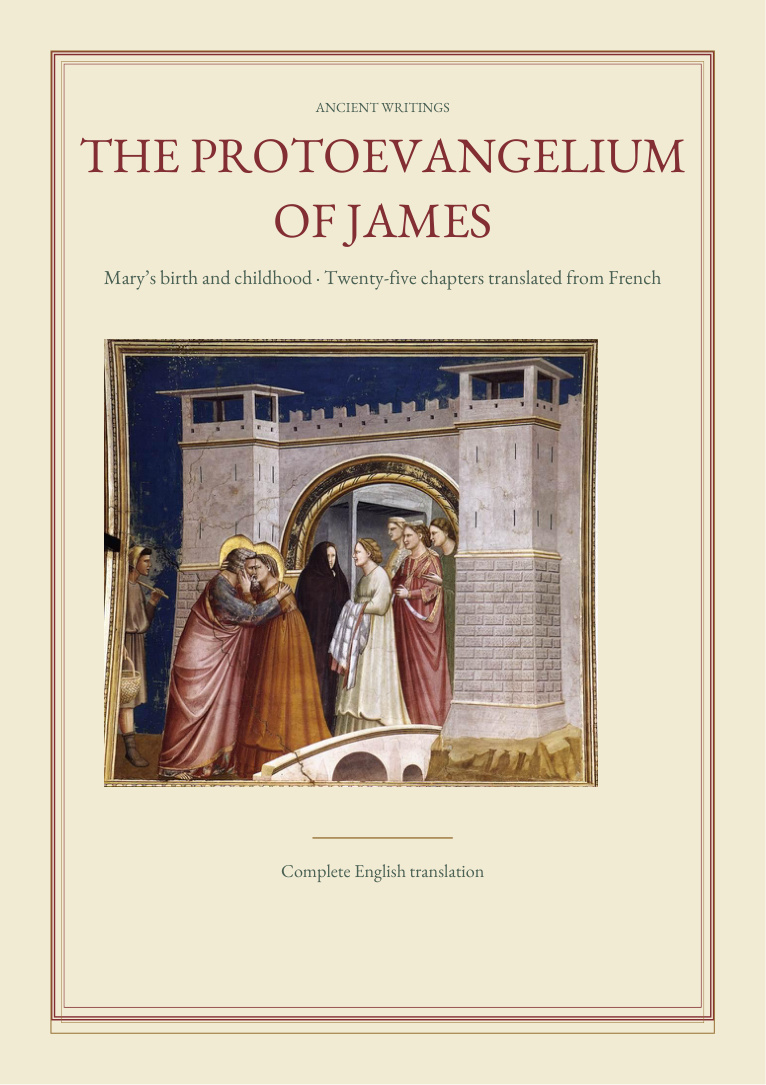
Joachim and Anna at the Golden Gate
Giotto di Bondone, fresco from the Life of Joachim cycle, c. 1303–1305, Scrovegni Chapel, Padua. Web Gallery of Art reproduction, distributed by Wikimedia Commons as a faithful reproduction of a public-domain work (PD-Art).
The Greek text in the 1876 edition
Constantin von Tischendorf’s printed edition, 1876, public domain. Digitisation available on Internet Archive; page extracted from the facsimile.
https://archive.org/details/evangeliaapocry00tiscgoog ↗
The end of the Protoevangelium in Papyrus Bodmer V
Fondation Martin Bodmer, digitised by Bodmer Lab, University of Geneva, image 039 of codex PB C. Creative Commons Attribution–NonCommercial 4.0 licence (CC BY-NC 4.0).
https://bodmerlab.unige.ch/fr/constellations/papyri/mirador/1072205366?page=039 ↗
Cover: Giotto, Meeting at the Golden Gate, c. 1303–1305. Scrovegni Chapel, Padua. A medieval interpretation of Joachim and Anna’s reunion recounted in chapter IV.