The Throne and the Seat
A son asks his father what the Throne and the Seat denote in the Quran. In reply, his father brings together the Queen of Sheba’s throne, royal practices and images from Arabic poetry. He also examines the role of angels and the meaning of the Throne’s eight bearers.
Sources and method of compilation
Historical context
Dating
The treatise goes back to al-Qāsim ibn Ibrāhīm al-Rassī, who died in 860. From the handwriting, the editor dates the Sanaa copy to around the twelfth–thirteenth centuries. The manuscript bears neither a date nor a copyist’s name.
Origin and preservation
A Yemeni copy is held in the library of the Great Mosque of Sanaa. The editor designates it by the Arabic letter jīm and compares its readings with those of other copies.
How the volume was compiled
Al-Qāsim ibn Ibrāhīm al-Rassī died in 246 AH (860). The edition’s witness ج is a copy from the library of the Great Mosque of Sanaa. It comprises 328 pages, with neither a date nor a copyist’s name. On palaeographic grounds, Jadbān dates it to the sixth or seventh century AH (approximately the twelfth–thirteenth centuries). He provides no shelfmark in his description on page 176.
The treatise’s presence in the Sanaa witness is attested by the variants the editor attributes to it in the body of the treatise. On page 658, ج and أ add the continuation “He has not begotten and has not been begotten” to the quotation from surah 112. On page 671, ج gives “the throne of every kingdom” where the main text has “the throne of every king”. On page 680, ج transmits a longer wording of the half-verse about the hundreds.
The Arabic reproduces the edition’s reading text, available electronically. The established text compares several copies. The bracketed Quranic references and internal title belong to the edition. The French translation, followed here in English, corrects four typographical references in the reproduced Arabic: Quran 2:255 (p. 658), 14:10 (p. 661), 89:22 and 2:210 (p. 681).
Quotations from the Psalter and Torah are translated in the Arabic form reported by the treatise. Two missing half-verses are marked by dots in the edition. The editor could not locate several verses attributed to poets in their collections. The French, followed here, marks terms that remain uncertain, notably in the poem about the banner (p. 680).
ʿAbd al-Karīm Aḥmad Jadbān (ed.), Majmūʿ kutub wa-rasāʾil al-imām al-Qāsim, ↗ volume I, Dār al-Ḥikma al-Yamāniyya, 1422 AH / 2001. Beginning of the treatise and title page, pp. 655–660.
Volume I, pp. 661–680. Text and apparatus, including readings from the Sanaa manuscript.
Volume I, pp. 681–685. End of the treatise and closing formula. ↗
Volume I, p. 176. Description of witness ج from the Great Mosque of Sanaa.
OpenITI, electronic transcription of the same edition, Tafsīr al-ʿarsh wa-l-kursī. ↗
Sources and references
Image provenance
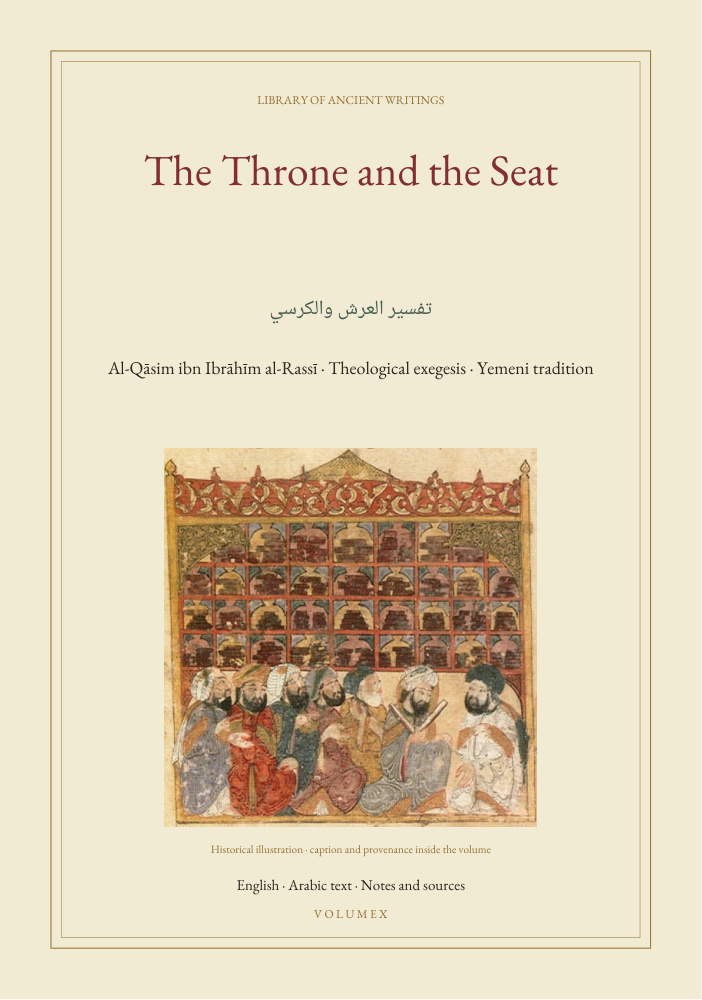
Yaḥyā al-Wāsiṭī, Maqāmāt of al-Ḥarīrī, 634 AH / 1236–1237. Paris, BnF, Arabe ↗ 5847, f. 5v.