The Covenant with the Children of Adam
Who answered God when he asked Adam’s descendants whether he was their Lord? The compiler sets the transmitted answers side by side. He then examines the trust refused by the heavens, the fate of peoples without a messenger, faith and the merits of Muḥammad. A prayer for the sultan unfolds according to the letters of the alphabet.
Sources and method of compilation
Historical context
Dating
The dedication to Qānṣūh al-Ghawrī places the copy within his reign in Egypt, between 1501 and 1516. The author and date of composition remain unknown.
Origin and preservation
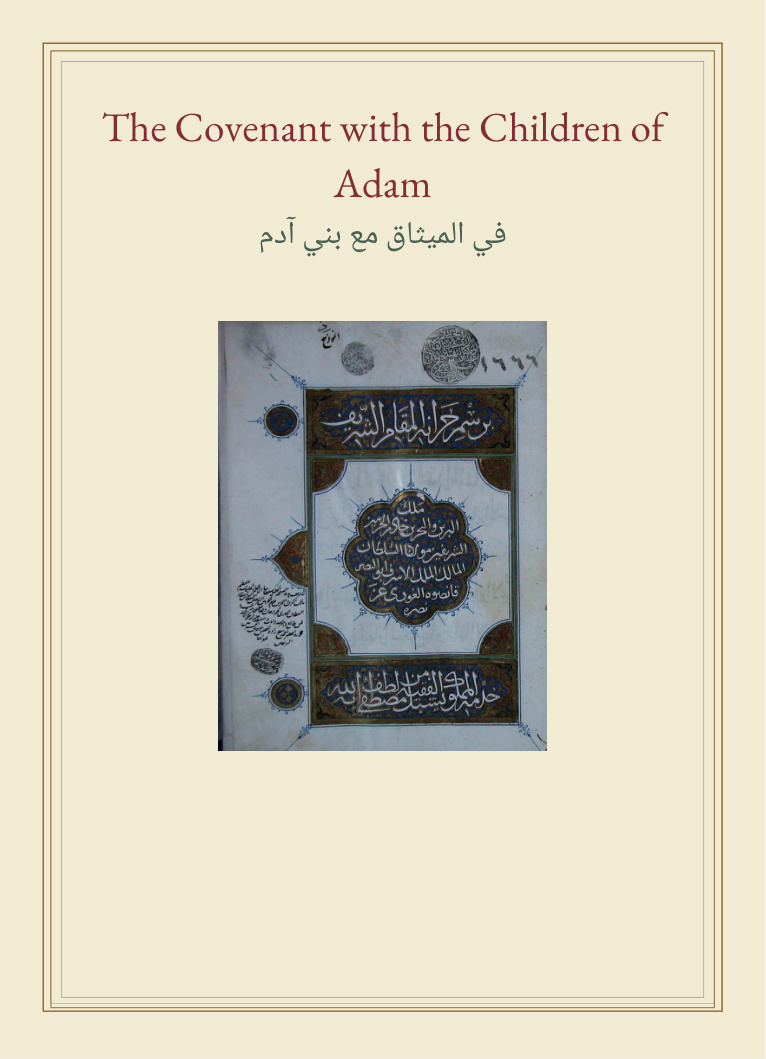
Istanbul, Süleymaniye Library, Ayasofya collection, manuscript 1666. The frontispiece names the sultan and the Mamluk Yašbak al-Faqīh, who presents the work to him. The copy comprises 134 folios.
How the volume was compiled
The flyleaf gives a designation relating to Sufism. The illuminated frontispiece bears the dedication, then the text opens with the contents of seven chapters. Yašbak al-Faqīh presents himself there as the sovereign’s servant. The dedication alone does not establish him as the author.
The traditions concerning the covenant develop Quran 7:172. The text varies the identities of the transmitters and the details of the scene without turning them into a uniform narrative. Quotations introduced by ‘it is reported’ retain their status as transmitted sayings.
The seven original headings remain visible in the Arabic text and in the translation. The contents add editorial subdivisions to the longest chapters. Spelling has been simplified for readability. Wherever the copy or its reproduction does not permit a secure reading, uncertainty remains indicated.
Several sayings are attributed to the Torah, David or other prophets by the transmitters of this Islamic collection. These attributions belong to the medieval text. Quranic references and the names of transmitters allow its own reasoning to be followed.
Sources and references
Read the manuscript witness and its catalogue entries
Complete colour facsimile, Ayasofya 1666, 135 views ↗
K. D’hulster, The Sultan’s Bookshelves, entry 37, pp. 96–98 ↗
Türkiye Yazma Eserler Kurumu Başkanlığı, manuscript catalogue ↗
Image credits
Cover. Istanbul, Süleymaniye, Ayasofya 1666, f. 1r. ↗
Arabic section · passage 1. Istanbul, Süleymaniye, Ayasofya 1666, f. 1v. ↗
Arabic section · passage 4. Istanbul, Süleymaniye, Ayasofya 1666, f. 24v. ↗
Translation · passage 7. Istanbul, Süleymaniye, Ayasofya 1666, f. 62r. ↗
Arabic section · passage 11. Istanbul, Süleymaniye, Ayasofya 1666, f. 100v. ↗
Translation · passage 12. Émile Prisse d’Avennes, L’Art arabe d’après les monuments du Kaire, ↗ 1877. Lithograph by L. Kuppenheim after an enamelled glass lamp from the Mosque of Barqūq.
Explanatory notes · passage 15. Istanbul, Süleymaniye, Ayasofya 1666, f. 134r. ↗