The Testaments of Abraham, Isaac and Jacob
Abraham welcomes the archangel Michael to his table. The guest has come to announce his death. The patriarch wishes to see the world before leaving it. Isaac and Jacob too learn that the time is coming to join their fathers. They speak to their children and consider the fate of the living after their own death.
Sources and method of compilation
Historical context
The manuscript
Vatican Apostolic Library · Vat. copt. 61 · ff. 143v–184v in the viewer, formerly 148v–189v
The witness and its transmission
The three accounts follow one another in a Bohairic Coptic manuscript dated 962. Two numberings appear on its pages. In the viewer, Abraham begins at f. 143v, Isaac at f. 159r and Jacob at f. 173r. The last account ends at f. 184v. The corresponding old numbers are 148v, 164r, 178r and 189v.
How the volume was compiled
The three French readings underlying this English version follow editions of the Coptic manuscript. For Abraham, the intermediary is Ernst Andersson’s German translation of 1903; for Isaac and Jacob, Stephen Gaselee’s English translation of 1927. The appendix presents Abraham’s short Greek recension for comparison, including the figures of the judge and witnesses in the judgement scene.
Sources and references
The title in the original language
Coptic heading of the first folio, ‘The three patriarchs’, transcribed in normalised letters. Gamma with a line above it represents three. The title names the three accounts gathered in the manuscript.
Manuscripts and editions
Vatican Apostolic Library · beginning of the Testament of Abraham ↗
Ernst Andersson, Abraham’s Vermächtnis, aus dem Koptischen übersetzt, Sphinx ↗ VI, 1903, pp. 220–236. Narrative text on pp. 220–234, followed by notes. ↗
University of Münster · research and boundaries of the Bohairic Testament of Abraham ↗
G. H. Box and Stephen Gaselee · English edition, London, 1927 ↗
Sources of the illustrations
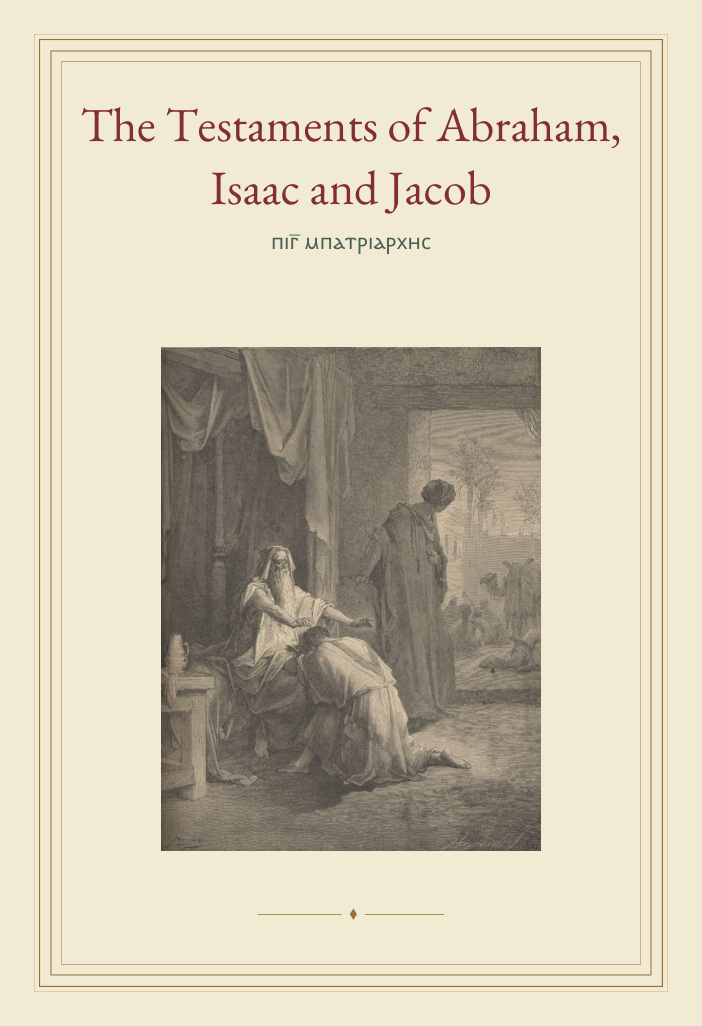
Cover illustration · Gustave Doré, Isaac Blessing Jacob, nineteenth century. ↗
Gustave Doré, Abraham Receives the Three Visitors, nineteenth century. ↗
Gustave Doré, Isaac Blesses Jacob, nineteenth century. ↗
The folio photographs come from the Vatican Apostolic Library. An edition intended for personal study.